Eating nuts may be one practical part of a brain-healthy eating pattern. A 2026 analysis of the Framingham Heart Study found that higher nut intake was associated with better global cognition in stroke-free adults, with stronger associations among people with poorer diet quality or lower physical activity. However, the study did not find a significant association between nut intake and developing stroke or dementia over 10 years, so the findings do not establish that nuts prevent cognitive decline or dementia.
Why a Small Food Choice Is Getting Big Brain-Health Attention
The global dementia burden is growing largely as populations age. The Global Burden of Disease study projected that the number of people living with dementia could rise from about 57 million in 2019 to nearly 153 million by 2050. That makes long-term brain health increasingly important; not as a promise that dementia can be prevented, but as a reason to pay attention to modifiable factors throughout adulthood. Diet, physical activity, cardiovascular health, sleep, cognitive engagement and social connection all form part of this broader picture.
Food matters because the brain depends on a continuous supply of energy, fatty acids, vitamins, minerals and other compounds while also being highly sensitive to vascular and metabolic health. Research on Mediterranean- and MIND-style eating patterns has therefore raised an important question: could individual foods within these patterns contribute something useful?
Nuts are particularly interesting because they combine unsaturated fats, plant protein, fibre, minerals, vitamins and bioactive plant compounds in a relatively small serving. A newly published 2026 study adds another piece to the puzzle by examining nut intake alongside cognition, brain volume, a vascular growth factor and long-term stroke and dementia outcomes.
Why Might Nuts Be Beneficial for the Brain?
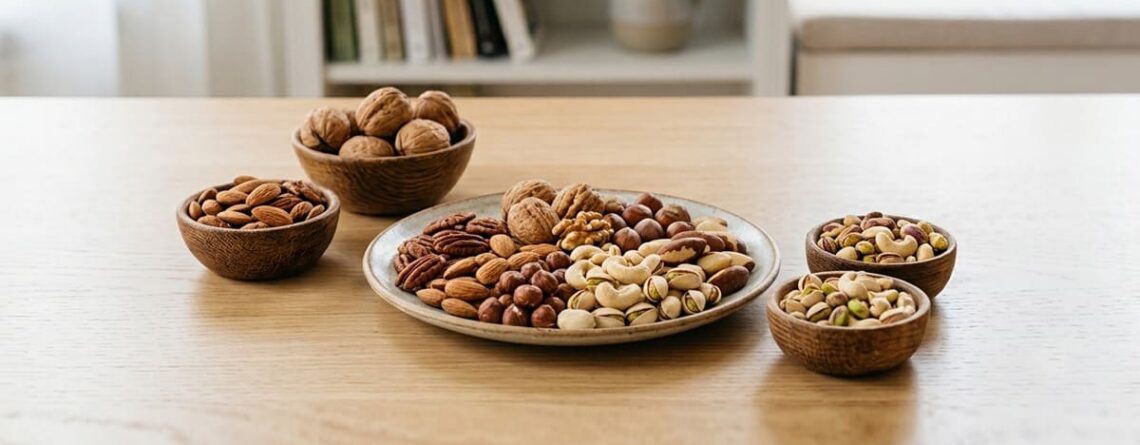
Nuts are nutritionally dense rather than simply being sources of fat. Almonds, walnuts, pistachios, peanuts, hazelnuts, pecans and other varieties provide different combinations of monounsaturated and polyunsaturated fats, protein, fiber, vitamin E, magnesium, folate and other micronutrients. They also contain phytochemicals such as polyphenols, phytosterols and other antioxidant compounds.
Several of these characteristics could plausibly support brain health indirectly. Unsaturated fats can contribute to a healthier cardiovascular profile, while fibre can influence metabolic health and the gut environment. Vitamin E and various plant compounds participate in antioxidant defences, and minerals such as magnesium contribute to normal nerve and cellular function. Nuts may also replace less nutritious snacks, which means their potential value can come not only from what they add but from what they displace.
That distinction is important. There is no established “nut nutrient” that independently protects the brain from dementia. Instead, nuts fit naturally into dietary patterns that emphasize minimally processed foods, vegetables, fruits, legumes, whole grains, fish and healthier fats. The National Institute on Aging similarly emphasizes overall healthy eating rather than relying on a single food to prevent cognitive decline.
The New 2026 Study: What Did Researchers Actually Find?
Amanat, Dordevic, Pase and Cardoso analysed data from 1,771 participants in the Framingham Heart Study Offspring cohort, including 29 people with a history of stroke. Participants had dietary information from food-frequency questionnaires and underwent cognitive assessment. Researchers examined global cognition, brain volume and blood-based markers, while a 10-year follow-up was used to investigate incident stroke and dementia.
Among 1,742 stroke-free participants included in the primary cognitive analysis, greater usual nut intake was associated with better global cognitive performance after adjustment for demographic, lifestyle and health-related factors. The association was expressed as a β of 0.007 for each additional gram of nut intake.
The more intriguing finding appeared when researchers looked at lifestyle context. The association with better cognition was stronger among participants with lower diet quality and among those with lower physical activity. In other words, the relationship was not simply “more nuts equals better cognition.” It appeared to vary according to what the rest of a person’s lifestyle looked like.
This is an important distinction because it raises the possibility that a relatively nutritious food could have greater relevance in people whose overall lifestyle leaves more room for improvement. But it is still an association, not proof that adding nuts to an otherwise unhealthy lifestyle will produce a measurable cognitive benefit.
What About Brain Volume?
The researchers also examined brain volume. Higher nut consumption was associated with greater brain volume among participants in the highest physical-activity group. This finding is interesting because brain volume is sometimes used as a broad structural marker in aging research, but it should not be interpreted as evidence that eating nuts literally makes the brain larger. Brain volume varies naturally between individuals and is influenced by age, sex, body size, vascular factors, health conditions and many other variables. The study’s finding is therefore better viewed as an exploratory structural association that supports further investigation. It does not establish that nuts preserve brain tissue or prevent age-related brain atrophy.
A Curious Finding in Stroke Survivors: VEGF
The study also examined vascular endothelial growth factor, or VEGF, a protein involved in blood-vessel formation and vascular signalling. Among the small group of stroke survivors, higher nut intake was associated with higher serum VEGF concentrations. That finding is biologically interesting because vascular health is closely connected with brain health, and blood-vessel remodelling and repair are important areas of stroke research. However, only 28 participants in the study had a history of stroke. That is far too small a subgroup to draw clinical conclusions about nuts, VEGF or recovery after stroke.
The finding should therefore be treated as a research lead rather than a therapeutic recommendation. Higher VEGF is not automatically equivalent to better brain function, and the study did not demonstrate that changing nut intake would alter stroke recovery.
Did Nuts Reduce Stroke or Dementia Risk?
Here the findings were much more cautious.
During the 10-year follow-up, researchers identified 49 incident strokes and 61 dementia cases. They did not find a significant association between nut intake and the development of either stroke or dementia. This is one of the most important points to retain when interpreting the headline findings. Better cognitive scores at one point in time do not necessarily translate into fewer future dementia diagnoses.
Previous observational research has produced mixed results. Some large cohort studies have reported associations between habitual nut consumption and lower dementia risk, while intervention studies examining nuts alone have generally provided much less convincing evidence for cognitive improvement. The difference may reflect study design, duration, dietary patterns, participant characteristics and the difficulty of isolating one food from an entire lifestyle.
How Much Were People Actually Eating?
One surprising feature of the 2026 Framingham analysis was the relatively low level of nut consumption. The median intake was approximately 1.3 grams per day, an amount equivalent to roughly one almond rather than a conventional handful. That matters when interpreting the study. The research did not establish that everyone needs to eat a large handful of nuts daily to obtain a cognitive benefit, nor did it identify an optimal brain-health dose. The researchers examined naturally occurring differences in habitual intake rather than assigning participants to a prescribed quantity.
For context, a commonly used serving of nuts is around 28–30 grams, but that amount should not be presented as a proven dementia-prevention dose. It is simply a practical serving size used in nutrition guidance and research.
How Could Nuts Potentially Connect Diet With Brain Health?
Several pathways could plausibly connect nut consumption with cognitive aging. Their unsaturated fats may support cardiovascular health, while fibre and plant compounds may contribute to metabolic and inflammatory pathways. Nuts can also provide vitamin E, magnesium and other micronutrients involved in cellular function.
The vascular pathway may be particularly relevant. The brain relies on an extensive blood-vessel network, and hypertension, diabetes, dyslipidaemia and other cardiovascular risk factors can affect cognitive aging. A food that contributes to a healthier overall dietary pattern may therefore influence brain health indirectly through the cardiovascular system.
There are also potential antioxidant and anti-inflammatory mechanisms, although mechanistic plausibility should not be confused with clinical proof. The human brain is affected by many interacting processes, including vascular function, metabolism, inflammation, oxidative stress and neurodegeneration. No single food acts on all of these pathways in isolation.
The Bigger Picture: Nuts Work Best as Part of a Pattern
The most useful lesson from the study may be less about nuts themselves and more about how brain health is approached. A handful of nuts cannot compensate for chronically poor sleep, physical inactivity, uncontrolled blood pressure, smoking or an overall low-quality diet. At the same time, a healthy diet does not need to be perfect. Small substitutions can accumulate over years.
Nuts can replace highly processed snacks, be added to oatmeal or yogurt, mixed into salads, incorporated into vegetable dishes or eaten alongside fruit. Unsalted or minimally processed varieties are generally easier to fit into a heart-healthy eating pattern than heavily salted or sugar-coated versions. The goal is not to turn one food into a “brain superfood.” It is to make nutrient-dense choices easier to repeat.
Practical Ways to Add Nuts to Your Diet
A modest portion of unsalted nuts can be used as a snack instead of highly processed foods. Chopped walnuts or almonds can be added to oats, yogurt or fruit; pistachios can accompany a meal; peanuts or natural peanut butter can add protein and healthy fats to whole-grain foods; and mixed nuts can provide variety.
Portion awareness still matters because nuts are energy-dense. For people with allergies, swallowing difficulties, specific kidney-related dietary restrictions or other medical nutrition needs, the appropriate choice can differ. Nut butters should also be selected carefully because some products contain substantial added sugar or sodium.
What Are the Study’s Main Limitations?
The 2026 study was observational, meaning researchers examined naturally occurring differences in diet rather than randomly assigning people to eat nuts or avoid them. Consequently, the study cannot prove that nuts caused the differences in cognition.
Diet was assessed using food-frequency questionnaires, which depend on participants accurately reporting their usual intake. People who eat more nuts may also differ in education, income, overall diet, exercise, healthcare access or other behaviours that are difficult to completely separate statistically.
The stroke subgroup was particularly small, with only 29 participants, making the VEGF findings preliminary. The number of dementia and stroke events was also limited relative to the entire cohort. Finally, the participants came from a specific longitudinal cohort, so the findings may not apply equally to every population or dietary culture. These limitations do not make the research unimportant. They simply define what the study can and cannot tell us.
What Does This Mean for Everyday Brain Health?
The emerging message is encouraging but deliberately modest: nuts can be a practical component of a nutrient-dense eating pattern that supports overall cardiovascular and metabolic health, while new research suggests that habitual nut intake is associated with better global cognition in some groups.
But the study does not show that nuts prevent dementia, prevent stroke, increase brain volume, or treat cognitive impairment. The absence of a significant association with incident dementia and stroke is particularly important.
For long-term brain health, the more meaningful strategy is cumulative. Choose nutritious foods regularly, stay physically active, maintain cardiovascular and metabolic health, sleep adequately, remain cognitively and socially engaged, and address hearing or vision problems when they arise. Nuts can fit comfortably within that broader approach, but they do not need to carry the entire burden of brain health.
Recent Research Highlights
The September 2026 Framingham analysis provides a useful new layer to the nutrition-and-cognition conversation: higher nut intake was associated with better global cognition, with stronger associations among participants with poorer diet quality or lower physical activity, while the study found no significant association with incident stroke or dementia over 10 years.
Other recent nutrition research continues to support a broader approach. Studies of healthy dietary patterns increasingly examine how diet interacts with physical activity, metabolic health and vascular risk rather than treating individual foods as isolated interventions. Research on Mediterranean- and MIND-style patterns remains promising but mixed, reinforcing the importance of distinguishing observational associations from randomized clinical evidence.
Recent Clinical Studies & Surveys
Evidence from intervention studies is more cautious than the observational literature. Earlier controlled studies of isolated nut supplementation have not consistently demonstrated improvements in cognitive performance, and studies in which nuts are included as one component of a broader dietary intervention cannot always determine the independent contribution of nuts.
More recent multidomain research similarly suggests that cognition may respond to combinations of diet, physical activity and vascular-risk management rather than to a single nutritional ingredient. This supports a whole-lifestyle model of cognitive wellness while leaving the specific cognitive effect of nuts an open research question.
Key Takeaways
- Nuts provide unsaturated fats, protein, fibre, vitamins, minerals and bioactive plant compounds.
- A 2026 Framingham study found higher nut intake was associated with better global cognition in stroke-free adults.
- The association was stronger among people with lower diet quality and lower physical activity.
- Higher nut intake was also associated with greater brain volume among highly active participants.
- Higher nut consumption was associated with serum VEGF among a very small group of stroke survivors.
- The study found no significant association between nut intake and developing stroke or dementia over 10 years.
- The median nut intake was only about 1.3 g/day, so the study did not establish an optimal serving for brain health.
- The findings are observational and do not prove that nuts cause better cognition.
- Nuts are best considered one component of an overall healthy dietary and lifestyle pattern.
- Long-term brain health depends on cumulative habits rather than a single “brain food.”
FAQ (Frequently Asked Questions)
-
Are nuts good for brain health?
Nuts are nutrient-dense foods that can fit well within dietary patterns associated with healthy aging. Recent research also found an association between higher nut intake and better global cognition, although this does not prove that nuts themselves caused the difference. -
Can eating nuts prevent dementia?
There is currently no evidence that eating nuts alone prevents dementia. Observational studies have produced encouraging but inconsistent findings, and the 2026 Framingham study did not find a significant association with incident dementia. -
How many nuts should I eat for brain health?
The 2026 study did not establish a specific brain-health dose. A typical nutrition serving is around 28–30 grams, but this should not be interpreted as a proven dementia-prevention amount. -
Which nuts are best for the brain?
There is no scientifically established single “best” nut. Almonds, walnuts, pistachios, peanuts, hazelnuts and other nuts provide different combinations of healthy fats, protein, fibre, micronutrients and plant compounds. -
Do walnuts improve memory?
Walnuts contain unsaturated fats and plant compounds that make them biologically interesting for brain-health research, but evidence does not establish that eating walnuts alone reliably improves memory in everyone. -
Can nuts increase brain volume?
The 2026 Framingham study found an association between higher nut intake and greater brain volume among highly physically active participants. This was observational and does not prove that nuts increase or preserve brain volume. -
What is VEGF, and why was it measured?
Vascular endothelial growth factor, or VEGF, is involved in blood-vessel growth and vascular signalling. The study found higher serum VEGF with greater nut intake among a very small subgroup of stroke survivors, making this an interesting but preliminary finding. -
Can nuts reduce stroke risk?
Nuts may contribute to cardiovascular health as part of a healthy diet, but the 2026 study did not find a significant association between nut intake and incident stroke during its 10-year follow-up. -
Are salted nuts healthy?
Unsalted or minimally salted nuts are generally easier to incorporate into a heart-healthy eating pattern because they avoid adding substantial sodium. Individual dietary needs can vary. -
Can nuts replace other brain-healthy foods?
Nuts should complement rather than replace the diversity of a healthy diet. Vegetables, fruits, whole grains, legumes, fish or other protein sources, and healthy oils provide different nutrients and compounds. -
Is a handful of nuts enough to protect the brain?
No single food can be expected to protect the brain by itself. Nuts can be one small, repeatable part of a broader lifestyle that includes physical activity, sleep, cardiovascular health and cognitive and social engagement. -
What is the most important lesson from the new study?
The main lesson is that nut intake may be associated with cognitive health, but the relationship is complex and appears to depend on the wider lifestyle context. The findings support further research rather than a prescription to eat nuts as a dementia-prevention strategy.
DISCLAIMER: The content of this article is intended solely for general informational purposes and is not a substitute for professional medical consultation, diagnosis, or treatment. Always seek the advice of your doctor or another qualified healthcare professional regarding any medical concerns.