Written by RecallLoop Editorial Team | Medically Review: Solely for general informational purposes and is not a substitute for professional medical consultation, subject to qualified clinician review | Updated: October 19, 2026
The Unexpected Connection Between Light And Brain Function
From Light to Neurons: The Emerging Science of Red-Light Therapy
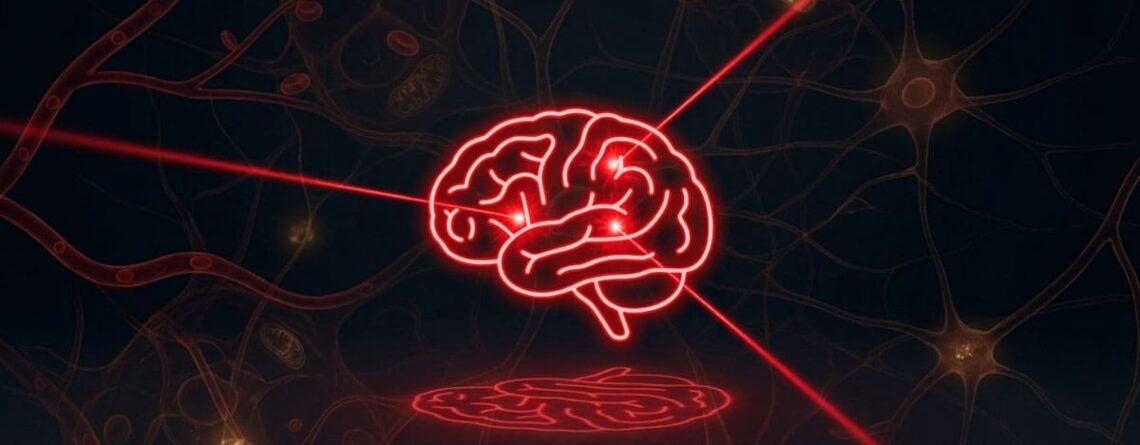
A beam of red light may appear unremarkable, but researchers are investigating whether carefully selected wavelengths can influence processes happening deep inside the brain. The question is not simply whether light reaches brain tissue, but whether it can change the way brain cells function.
This emerging field is called photo biomodulation (PBM). When light is directed toward the head to investigate effects on brain function, the approach is known as transcranial photo biomodulation (tPBM).
The scientific interest canters on mitochondria, the structures that help cells produce energy, alongside possible effects on cerebral blood flow, oxygen metabolism and cellular signalling. Because neurons depend on energy to communicate, learn and form memories, these processes offer potential targets for neurological research.
Yet a plausible biological mechanism does not automatically establish a successful treatment. Although recent human studies have reported encouraging cognitive findings, researchers are still determining which protocols work, who might benefit, how long improvements last and whether those changes translate into meaningful everyday outcomes.
Table of Contents
- How Red and Near-Infrared Light May Influence Neurons
- What Human Studies Reveal About Memory and Cognition
- Why Wavelength, Dosage and Device Design Matter
- Recent Clinical Studies & Scientific Developments
- Real-World Documented Case in Practice
- Frequently Asked Questions
- What the Future of Brain Photobiomodulation May Hold
How Red and Near-Infrared Light May Influence Neurons
Photobiomodulation uses selected wavelengths of low-intensity light to influence biological activity without deliberately heating or destroying tissue.
Researchers commonly investigate red and near-infrared wavelengths. Near-infrared light is particularly interesting because some wavelengths penetrate biological tissue more effectively than visible red light, although only a portion of the delivered energy may reach deeper structures.
One proposed mechanism involves cytochrome c oxidase, an enzyme within the mitochondrial electron-transport chain. Scientists have suggested that light-sensitive interactions with this system may influence cellular energy production, oxygen utilization and nitric-oxide signalling.
Other proposed effects include changes in cerebral blood flow, oxidative signalling and neural-network activity. These mechanisms could help explain possible cognitive effects, but their relative importance in living human brains remains under investigation.
Understanding how photo biomodulation works also means recognizing what the current evidence does and does not establish:
- Cellular response is not clinical proof: Changes in mitochondrial activity do not automatically demonstrate better memory or protection against neurodegeneration.
- Brain-directed treatment is not ordinary skin treatment: A cosmetic LED mask or red-light panel cannot be assumed to deliver the same dose to the brain as a research device.
- Penetration is not guaranteed delivery: The amount of light reaching brain tissue depends on wavelength, tissue thickness, anatomical location and device characteristics.
These distinctions matter because a biological effect is only the beginning. Researchers must also demonstrate whether a specific treatment produces measurable benefits in people.
What Human Studies Reveal About Memory and Cognition
Human studies suggest that photo biomodulation may improve selected cognitive measures, but the evidence varies by population, treatment protocol and outcome.
A 2025 systematic review and meta-analysis by Zhu and colleagues, published in Lasers in Medical Science, included 24 randomized controlled trials involving 820 participants. The authors reported improvements in pooled measures of global cognition, working memory, attention and aspects of executive function, while emphasizing that study heterogeneity and methodological limitations warrant caution.
Research involving neurological conditions has also produced encouraging findings. However, results from people with mild cognitive impairment or traumatic brain injury cannot automatically be applied to healthy adults seeking better concentration or memory.
For readers evaluating these claims, several questions are more useful than a simple yes-or-no verdict:
- Check the population: Was the study conducted in healthy volunteers or people with a diagnosed neurological condition?
- Identify the outcome: Did researchers measure memory, attention, symptoms or everyday functioning?
- Examine the comparison group: Sham-controlled trials help distinguish treatment effects from expectations and practice effects.
- Look for lasting benefits: Short-term improvements do not establish durable cognitive enhancement or disease prevention.
The growing number of clinical trials makes the field increasingly interesting, but differences between devices and treatment schedules remain a major obstacle to drawing universal conclusions.
Why Wavelength, Dosage and Device Design Matter
There is currently no single universally established photo biomodulation protocol for improving brain health.
Studies differ in wavelength, light intensity, energy delivered per unit area, pulsing pattern, treatment duration, frequency and the brain region targeted. Devices that emit similar wavelengths may still deliver substantially different doses. The route of delivery also matters. A device positioned against the forehead, a helmet and an intranasal device do not necessarily expose the same tissues to the same amount of light.
Researchers are investigating several potential applications:
- Cognitive performance: Studies examine attention, working memory and executive function.
- Mild cognitive impairment: Trials investigate whether PBM can influence cognitive outcomes in people already experiencing measurable difficulties.
- Traumatic brain injury: Researchers are exploring possible effects on cognition and persistent post-concussion symptoms.
- Sleep and alertness: A 2025 systematic review examined emerging evidence concerning sleep, wakefulness and cognition, identifying opportunities for further research rather than establishing a standard treatment.
A product’s marketing claims cannot substitute for evidence from the specific device and protocol being studied. This is especially important when companies use broad phrases such as “brain optimization” without identifying the clinical outcomes their products have demonstrated.
Recent Clinical Studies & Scientific Developments
Recent research illustrates both the progress of photo biomodulation and the need for careful interpretation.
A 2025 cognitive meta-analysis: Zhu and colleagues synthesized 24 randomized trials involving 820 participants. Their findings support further investigation of PBM for cognitive outcomes, but differences across studies mean the results cannot establish that every device or application works equally well.
A 2025 traumatic brain injury trial: Lee and colleagues reported a randomized, placebo-controlled study involving 17 people with mild traumatic brain injury. Participants showed improvements in visual working memory, verbal learning, sleep quality and several self-reported symptoms after active tPBM, whereas comparable significant improvements were not observed after sham treatment. The small sample means these findings require confirmation in larger trials.
A 2026 mild cognitive impairment trial: Chun and colleagues conducted a randomized, double-blind, placebo-controlled study involving 80 participants with mild cognitive impairment due to Alzheimer’s disease. Participants used a home-administered 808-nm near-infrared device over the bilateral dorsolateral prefrontal cortex six times weekly for 12 weeks. The active-treatment group showed greater improvement in several cognitive assessments than the placebo group, and the researchers reported no device-related adverse events during the trial.
A 2026 pilot study: Woźniak-Mitał and colleagues investigated transcranial direct-current stimulation combined with intranasal near-infrared stimulation in 33 participants with mild cognitive impairment or Alzheimer’s disease. Because the study combined two interventions, its findings cannot establish the effectiveness of photo biomodulation alone.
Taken together, these studies show that PBM is moving beyond laboratory hypotheses into controlled human research. They do not establish that it prevents Alzheimer’s disease, reverses neurodegeneration or produces lasting cognitive improvements for everyone who uses it.
Real-World Documented Case in Practice
The 2026 randomized trial by Chun and colleagues provides a documented example of PBM being tested in a practical setting. The researchers evaluated a home-administered near-infrared device in 80 participants with mild cognitive impairment attributed to Alzheimer’s disease. Participants used the device for 12 weeks, allowing researchers to compare cognitive outcomes between active treatment and placebo under a defined protocol.
The active-treatment group demonstrated greater improvements on several cognitive assessments. The researchers also reported high adherence and no device-related adverse events during the trial. These results are encouraging, but the study does not prove that a consumer red-light product will reproduce the same effects. The researchers tested a specific device, wavelength, treatment schedule and participant population over a limited period.
The practical lesson is that home administration may be feasible under a defined research protocol, but short-term improvement is not the same as established long-term effectiveness.
Frequently Asked Questions
-
What is red light therapy for the brain?
It usually refers to transcranial photo biomodulation, which uses selected red or near-infrared wavelengths directed toward the head. Researchers are investigating its effects on brain physiology and cognition. -
Is photo biomodulation the same as infrared therapy?
Not necessarily. PBM can use red or near-infrared light, while other infrared treatments may use different wavelengths, intensities or delivery methods. -
Can near-infrared light penetrate the skull?
Some near-infrared light can pass through biological tissues, but only a portion of the delivered energy may reach deeper structures. The amount depends on wavelength, anatomy and device characteristics. -
Can red light therapy improve concentration?
Some studies report changes in attention and executive-function measures, but the evidence is insufficient to recommend PBM routinely for concentration in healthy adults. -
Can photo biomodulation prevent Alzheimer’s disease?
Prevention has not been established. Studies involving people with mild cognitive impairment do not prove that PBM prevents disease or changes its long-term progression. -
Is red light therapy being studied after concussion?
Yes. Small clinical studies have investigated cognition and post-concussion symptoms after mild traumatic brain injury, but larger controlled trials are needed. -
Why do studies use different wavelengths?
Wavelength affects how light interacts with tissue and how deeply it may penetrate. Researchers are still determining which wavelengths and delivery parameters are appropriate for different applications. -
Is brain photo biomodulation safe?
Some trials report good short-term tolerability, but safety depends on the device, treatment protocol and individual circumstances. Long-term safety across all neurological applications remains uncertain. -
Can I use a cosmetic red-light panel on my head?
A cosmetic panel is not necessarily designed or tested for transcranial treatment. Do not assume it reproduces the dose or safety profile of a research device. -
Does photo biomodulation increase blood flow to the brain?
Changes in cerebral blood flow have been reported or proposed in PBM research, but the magnitude and clinical significance vary. A change in blood flow alone does not prove better cognition. -
Can PBM replace medication or rehabilitation?
No. It should not replace medical assessment, prescribed treatment or rehabilitation for neurological conditions without guidance from a qualified healthcare professional. -
What evidence would make PBM more convincing?
Larger independent randomized trials, standardized treatment parameters, longer follow-up and demonstrated improvements in everyday functioning would strengthen the evidence for clinical use.
What the Future of Brain Photo biomodulation May Hold
The scientific appeal of PBM lies in its potential to influence cellular processes that support brain function without invasive procedures. Its future depends on whether those biological effects translate into reliable, meaningful and lasting benefits for people.
Researchers still need to establish which protocols work best, which populations are likely to benefit, how long improvements persist and whether treatment changes everyday functioning rather than only cognitive-test scores. Independent replication and longer-term safety data will also be essential.
For those interested in cognitive wellness, the key is to understand what current research supports, recognize its limitations, and evaluate claims about memory, brain function and dementia prevention before investing in red light therapy devices.
The next major advance may come from establishing when, how and for whom these biological effects translate into meaningful clinical benefits, not simply from demonstrating that red and near-infrared light can influence cellular processes.
RecallLoop encourages readers to follow emerging neuroscience while prioritizing evidence-based healthcare, regular physical activity, restorative sleep and appropriate medical assessment for persistent cognitive concerns.
DISCLAIMER: The content of this article is intended solely for general informational purposes and is not a substitute for professional medical consultation, diagnosis, or treatment. Always seek the advice of your doctor or another qualified healthcare professional regarding any medical concerns.