Could Your Diet Be Putting Your Brain at Risk? The Harvard Study Explained
What if the food on your plate could influence more than your waistline or heart health? Increasing evidence suggests that diet may also be connected to how the brain ages. A new Harvard-led study has added to that conversation by examining ultra-processed food consumption and cognitive health in older adults. Published in the American Journal of Public Health in 2026, the study followed data from 5,370 participants in the U.S. Health and Retirement Study and found that people consuming the highest levels of ultra-processed foods had higher risks of dementia and cognitive impairment than those consuming the lowest levels. That headline can sound alarming. But the science is more nuanced than “processed food causes dementia.” The study was observational, meaning researchers identified an association rather than proving cause and effect. Nevertheless, it adds to a growing body of research suggesting that what replaces ultra-processed food in the diet may matter for brain health.
What Counts as an Ultra-Processed Food?
“Processed” does not automatically mean unhealthy. Freezing vegetables, pasteurising milk, cooking beans or grinding grains are all forms of processing. Ultra-processed foods are different. They are generally industrial formulations made using multiple ingredients and processing techniques and often contain additives, flavourings, colourings, sweeteners or other substances not typically used in home cooking. Examples can include packaged snacks, sugary drinks, processed meats, many ready-to-eat meals, packaged desserts and some highly formulated breakfast products.
Importantly, the category is broad. Not every food classified as ultra-processed has the same nutritional profile, and researchers continue to debate how well the NOVA classification captures the health effects of individual foods.
What Did the New Harvard Study Actually Find?
The 2026 study used information from the Health and Retirement Study, a nationally representative longitudinal study of older U.S. adults. Researchers analysed dietary information and followed participants’ cognitive outcomes between 2013 and 2020. Among the 5,370 participants, those in the highest fifth of ultra-processed food consumption had a 58% higher risk of dementia and a 46% higher risk of cognitive impairment without dementia compared with those in the lowest fifth. The researchers also found lower risks among people consuming more unprocessed or minimally processed foods.
These numbers are important; but they need context. The researchers did not randomly assign people to eat more or less ultra-processed food. Participants already had different diets, lifestyles, health conditions and socioeconomic circumstances. Although statistical adjustments attempted to account for many of these factors, observational research cannot eliminate every possible confounder. So, the scientifically responsible conclusion is not that eating a particular packaged food will cause dementia. Rather, higher ultra-processed food consumption was associated with poorer cognitive outcomes in this population.
A Real-World Example from the Study
The most useful “real-life example” here is actually the study population itself. These were 5,370 real older U.S. adults, whose dietary patterns and cognitive outcomes were examined over several years. Researchers were not studying whether one person eating a packet of biscuits suddenly developed memory loss. They were looking at patterns across thousands of people.
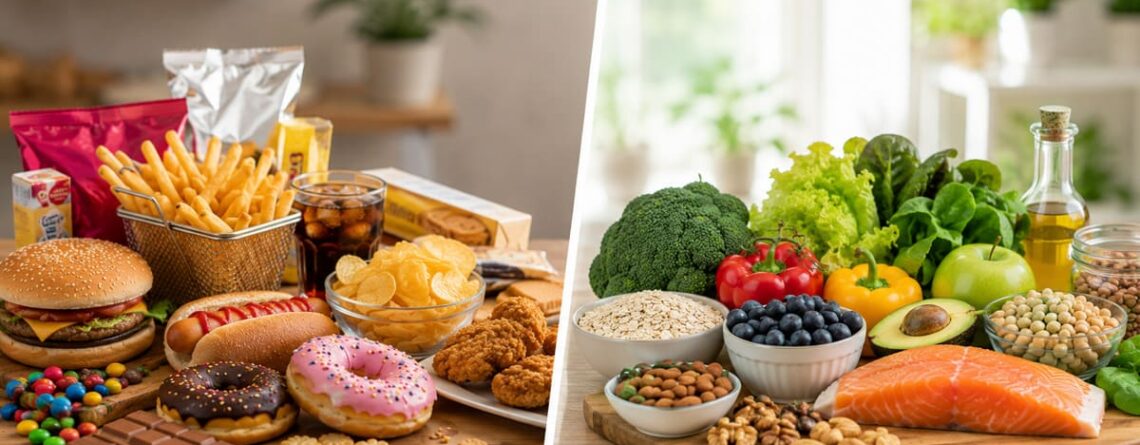
Imagine two people with otherwise similar lifestyles: one obtains a relatively large share of daily calories from packaged snacks, processed meats, sweetened products and ready-to-eat foods, while the other gets more of their diet from vegetables, fruits, whole grains and other minimally processed foods. The study suggests that, across a population, the second dietary pattern may be associated with better cognitive outcomes. It does not mean that diet alone determines either person’s future brain health.
That distinction is crucial.
Why Might Diet Affect the Brain?
Researchers are investigating several possible pathways. One involves cardiovascular and metabolic health. Diets high in added sugars, sodium and unhealthy fats can contribute to obesity, high blood pressure, abnormal cholesterol and diabetes. These conditions can damage blood vessels and are themselves associated with cognitive decline and dementia risk.
Another possibility involves inflammation and metabolic dysfunction. Researchers are investigating whether dietary patterns high in ultra-processed foods may influence inflammatory processes, oxidative stress and metabolic signalling that could affect the brain. The gut-brain connection is another active area of research. Dietary patterns can influence the gut microbiome, which interacts with immune, metabolic and nervous-system pathways. However, many of the specific mechanisms proposed between ultra-processed foods, the microbiome and neurodegeneration remain under investigation. There is therefore a difference between saying “researchers have plausible biological explanations” and saying “scientists have proven exactly how these foods cause dementia.” The first is supported; the second goes beyond current evidence.
Brain Health Connection: Is It the Food or the Overall Pattern?
Perhaps the most important insight is that brain health cannot be reduced to one ingredient. A diet is a pattern. Someone who eats a packaged snack occasionally while otherwise consuming vegetables, fruit, legumes, whole grains, nuts, fish and other nutrient-dense foods is very different from someone whose diet is dominated by highly processed products. This is why dietary patterns such as Mediterranean-style and MIND-style eating continue to attract attention in cognitive-health research. The goal is not to create a “perfect brain diet.” It is to build a dietary pattern that provides nutrients and fibre while supporting cardiovascular and metabolic health.
What Should You Actually Change?
The Harvard findings do not mean you need to empty your kitchen overnight. A more practical approach is to reduce rather than obsess over eliminating every processed food. Instead of focusing on individual “bad” foods, consider what you can add:
Choose whole or minimally processed foods more often. Make vegetables, fruits, legumes, whole grains, nuts and seeds regular parts of meals. Include appropriate sources of protein and healthy fats. When buying packaged foods, compare labels for sodium, added sugars, saturated fat and fibre. Harvard Health also recommends practical substitutions rather than expecting people to eliminate processed foods completely. The key question becomes: What can replace the ultra-processed food?
Replacing a packaged snack with fruit and nuts, or a highly processed meal with a simple meal containing vegetables, whole grains and a protein source, changes the overall dietary pattern without demanding perfection.
Recent Research Highlights
The 2026 Harvard-led study is not an isolated finding. A 2023 JAMA Neurology cohort study involving 10,775 adults aged 35–74 found that higher ultra-processed food consumption was associated with faster global cognitive and executive-function decline over a median eight-year follow-up.
A 2026 meta-analysis pooled eight prospective cohort studies involving more than 250,000 participants. Higher ultra-processed food intake was associated with a 14% higher risk of cognitive impairment, although substantial variation existed between studies.
Another 2026 study of 2,192 Australian adults aged 40–70 found that each 10% increase in ultra-processed food intake was associated with poorer attention scores and a higher calculated dementia-risk score. These studies strengthen the consistency of the association, but they do not turn observational evidence into proof of causation.
Recent Clinical Studies & Surveys
Recent research also illustrates why the story is more complicated than simply “processed versus healthy.” A 2026 analysis of 1,408 older U.S. adults found that higher ultra-processed food intake showed a trend toward greater executive-function impairment, but associations with other cognitive domains were not statistically significant.
A separate 2026 study involving 92 older adults found an association between higher ultra-processed food consumption and mild cognitive impairment. However, the association weakened after adjustment for inflammatory biomarkers, highlighting how difficult it is to determine the biological pathways involved. These smaller studies are useful because they show that not every study produces identical results. Scientific credibility comes from acknowledging both the signal and the uncertainty.
Can a Healthy Diet Protect the Brain?
The evidence is increasingly supportive of healthy dietary patterns, but “protect” should be interpreted carefully. Research suggests that diets rich in vegetables, fruits, whole grains, legumes, nuts and other nutrient-dense foods are associated with better cardiovascular and cognitive outcomes.
Recent Harvard-linked research has also continued investigating the MIND diet and brain structure, with 2026 findings suggesting that closer adherence may be associated with preservation of certain aspects of brain structure during aging. However, no diet can guarantee that a person will avoid dementia. Genetics, cardiovascular health, education, physical activity, sleep, social factors and many other influences also contribute to cognitive aging.
The Bigger Lesson from the Harvard Study
The most useful message is not “never eat ultra-processed food.” It is that diet quality may be one of the modifiable factors connected to long-term cognitive health. A person’s diet does not have to be perfect. In fact, trying to achieve dietary perfection can make healthy eating unnecessarily complicated.
Instead, think about the direction of your eating pattern. Are minimally processed foods becoming the foundation of your meals? Are vegetables, fruits, whole grains, legumes, nuts and other nutrient-dense foods appearing regularly? Are highly processed snacks and ready-to-eat products becoming occasional choices rather than dietary staples? Those changes may be more realistic and more sustainable, than chasing a perfect menu.
Key Takeaways
- A 2026 Harvard-led study found higher ultra-processed food intake was associated with greater risks of dementia and cognitive impairment.
- The study involved 5,370 older U.S. adults.
- The research was observational and does not prove that ultra-processed foods directly cause dementia.
- Other cohort studies and a 2026 meta-analysis have reported similar associations.
- The potential pathways include cardiovascular health, metabolic dysfunction, inflammation and gut-brain interactions, but mechanisms remain under investigation.
- Brain health depends on overall lifestyle and health, not one food.
- Replacing some ultra-processed foods with minimally processed, nutrient-dense foods is a practical approach.
- A healthy diet may support brain health, but no diet guarantees prevention of dementia.
FAQ (Frequently Asked Questions)
- What did the new Harvard study find about ultra-processed foods?
The 2026 Harvard-led study found that older adults consuming the highest amounts of ultra-processed foods had higher risks of dementia and cognitive impairment than those consuming the least. - Does ultra-processed food cause dementia?
The study does not prove causation. It found an association between higher consumption and cognitive outcomes. Other factors may partly explain the relationship. - What foods are considered ultra-processed?
Examples can include many packaged snacks, sugary drinks, processed meats, packaged desserts and highly formulated ready-to-eat products. Classification depends on the ingredients and degree of industrial processing. - Should I completely eliminate ultra-processed foods?
Not necessarily. A practical approach is to reduce them and make minimally processed foods the foundation of your diet. - Can a healthy diet prevent dementia?
No diet can guarantee prevention. Healthy eating may contribute to better cardiovascular and cognitive health, but dementia has multiple interacting risk factors. - Does processed food affect memory specifically?
Evidence is mixed across cognitive domains. Some studies have found associations with global cognition and executive function, while findings for memory alone have been less consistent. - Why might ultra-processed foods affect brain health?
Researchers are investigating pathways involving metabolic health, cardiovascular disease, inflammation, oxidative stress and the gut microbiome. No single mechanism has been definitively established. - Is all processed food unhealthy?
No. Processing can make foods safer, more convenient or more nutritious. The concern is particularly about highly formulated ultra-processed products and the overall dietary pattern. - What should I eat more of for brain health?
A varied diet rich in vegetables, fruits, whole grains, legumes, nuts and other nutrient-dense foods is consistent with dietary patterns associated with better cardiovascular and cognitive health. - Can brain-training exercises cancel out an unhealthy diet?
There is no evidence that cognitive training can “cancel out” dietary risk. Brain health is influenced by multiple factors, so cognitive engagement should complement; not replace healthy lifestyle habits. - Should I worry if I eat ultra-processed food occasionally?
Occasional consumption does not mean that you are damaging your brain. Research generally examines dietary patterns over time rather than the effect of one meal or snack. - When should memory problems be medically evaluated?
Persistent or worsening memory problems that interfere with work, relationships or everyday activities should be discussed with a qualified healthcare professional rather than attributed automatically to diet or normal aging.
DISCLAIMER: The content of this article is intended solely for general informational purposes and is not a substitute for professional medical consultation, diagnosis, or treatment. Always seek the advice of your doctor or another qualified healthcare professional regarding any medical concerns.