Can Sound Waves Help Fight Brain Cancer? Scientists Are Exploring A New Approach
Written by RecallLoop Editorial Team | Medical Review: Solely for general informational purposes | Updated: November 3, 2026
A sound wave cannot simply travel through the skull and destroy a brain tumour. But scientists are exploring a more precise possibility: using focused ultrasound as a delivery tool that helps therapeutic molecules reach parts of the brain that are otherwise difficult to treat.
That distinction matters in glioblastoma, an aggressive brain cancer whose cells can infiltrate surrounding brain tissue while the blood-brain barrier restricts the movement of many drugs from the bloodstream into the brain.
In a 2026 study published in the Journal of Clinical Investigation, researchers at the University of Virginia combined MRI-guided focused ultrasound, microbubbles, brain-penetrating nanoparticles, and microRNAs to deliver cancer-targeting molecules into glioblastoma models. The treatment slowed tumour growth and extended survival in mice, but it has not yet been shown to treat glioblastoma safely or effectively in humans.
This research is less about sound waves killing cancer and more about whether ultrasound can open a temporary delivery route for therapies designed to attack several cancer-driving mechanisms at once.
What Makes Glioblastoma So Difficult to Treat?
Glioblastoma is difficult to control because its cells are invasive, biologically diverse, and protected by the brain’s blood-brain barrier.
Unlike a tumour that remains neatly contained in one location, glioblastoma cells can spread into surrounding brain tissue. Removing the visible tumour therefore does not necessarily remove every malignant cell.
The blood-brain barrier adds another obstacle. This protective network of blood vessels helps regulate what enters brain tissue, which is essential for normal brain function but can also restrict the delivery of some potentially useful cancer therapies.
That creates a difficult treatment problem: a therapy may have activity against cancer cells but still struggle to reach enough of those cells inside the brain.
- Think beyond the visible tumour: Glioblastoma cells can extend into surrounding tissue.
- Separate delivery from drug activity: A promising molecule is only useful if it can reach its intended target.
- Recognize the barrier’s protective purpose: The blood-brain barrier is not simply an obstacle to overcome; it is a vital part of brain protection.
This is why researchers are investigating technologies that can temporarily change how much therapeutic material reaches a precisely selected brain region.
How Focused Ultrasound Could Open a Temporary Delivery Route
Focused ultrasound can work with microbubbles to temporarily increase blood-brain barrier permeability in a targeted area.
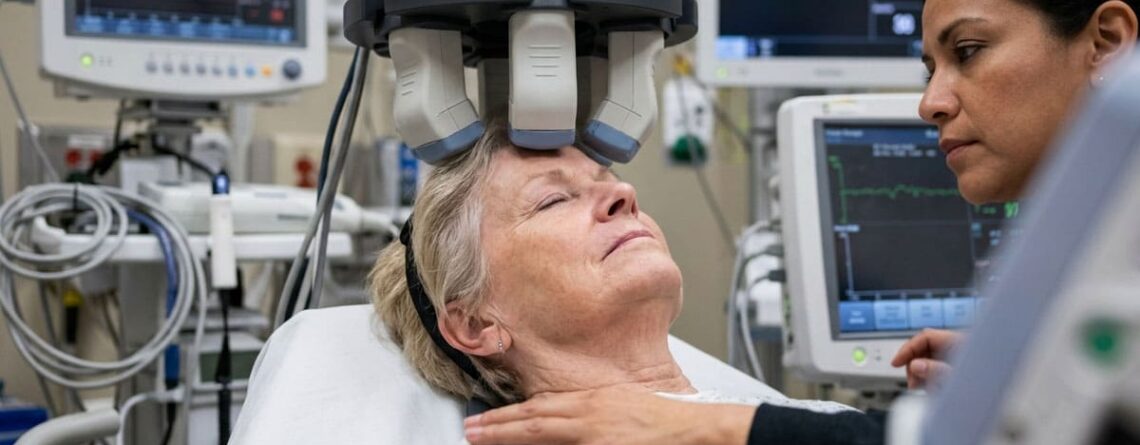
The technique uses sound waves concentrated at a specific location rather than exposing the entire brain to ultrasound energy. Tiny gas-filled microbubbles are administered into the bloodstream, where ultrasound causes them to interact with the blood vessel walls.
Under controlled conditions, this interaction can produce a temporary and reversible opening of the blood-brain barrier. MRI can then help researchers identify and target the intended region.
The 2026 JCI study used this principle alongside brain-penetrating nanoparticles carrying selected microRNAs. The nanoparticles served as delivery vehicles, while focused ultrasound and microbubbles helped the therapeutic material cross the normally restrictive barrier.
- Use MRI guidance: Precise imaging helps identify where ultrasound should be focused.
- Open the barrier temporarily: The objective is controlled delivery, not permanent disruption.
- Pair delivery with a therapeutic payload: Ultrasound itself is not the cancer treatment being tested in this approach.
That combination becomes particularly interesting when the payload is designed to influence several cancer pathways rather than just one.
Why MicroRNAs Could Attack Several Cancer Pathways at Once
MicroRNAs are small regulatory molecules that can influence the activity of multiple genes, making them attractive candidates for tackling the biological complexity of glioblastoma.
Cancer cells do not depend on a single malfunctioning gene or pathway. Glioblastoma can involve networks controlling cell growth, survival, invasion, and other processes, which can contribute to treatment resistance.
In the JCI study, researchers identified miR-340 and miR-382 as tumour-suppressive microRNAs and investigated miR-17 as an oncogenic microRNA target. Their analyses indicated that these molecules could affect multiple genes and pathways relevant to glioblastoma biology. The delivery problem remained. The researchers therefore combined the microRNAs with brain-penetrating nanoparticles and MRI-guided focused ultrasound with microbubbles.
This is the key innovation: the approach combines a biological strategy for influencing several cancer mechanisms with a physical strategy for getting the treatment into the brain.
For readers following developments in brain cancer research, the distinction is important. The study does not establish a new cancer treatment for patients; it provides preclinical evidence that this particular delivery strategy can work in animal models. And that is where the strongest evidence from the study begins and ends.
What the 2026 JCI Study Actually Found
The researchers found slower tumour growth and longer survival in several mouse glioblastoma models after focused-ultrasound-assisted microRNA delivery.
The team first identified microRNAs that could regulate multiple glioblastoma-related targets through laboratory screening and analysis of cancer datasets. They then tested the therapeutic approach in cell-based experiments and animal models.
In mice carrying established glioblastoma tumours, delivery of miR-340 or miR-382 using focused ultrasound, microbubbles, and brain-penetrating nanoparticles reduced tumour burden and extended survival compared with control treatment. The findings were also reproduced in a patient-derived glioma stem-cell model.
The researchers found that the ultrasound component mattered. In one comparison, nanoparticles carrying the therapeutic microRNAs without focused-ultrasound-mediated delivery did not produce the same reduction in tumour burden, supporting the importance of the delivery step.
- Laboratory evidence: The selected microRNAs altered cancer-related cellular behaviours.
- Animal evidence: Treated tumours showed reduced growth and improved survival compared with controls.
- Delivery evidence: Focused ultrasound and microbubbles helped the therapeutic nanoparticles reach the tumour region.
But these were preclinical results. The study did not demonstrate improved survival in people with glioblastoma, establish a safe human dose, or prove that the approach will work in clinical treatment.
That distinction becomes clearer when this technology is compared with what focused ultrasound has already achieved in human studies.
Recent Clinical Studies & Scientific Developments
Research published in 2026 is advancing focused ultrasound from an experimental drug-delivery concept toward a broader area of investigation in brain cancer treatment.
One of the most significant developments appeared in the Journal of Clinical Investigation on June 30, 2026. Researchers at the University of Virginia reported a strategy combining MRI-guided focused ultrasound, microbubbles, brain-penetrating nanoparticles, and microRNAs to target multiple cancer-related pathways in glioblastoma.
In laboratory experiments and mouse models, the approach reduced tumour growth and extended animal survival. The findings provide preclinical evidence for a new way of delivering gene-regulating molecules into the brain, but the specific microRNA treatment has not yet been tested as an established therapy in human patients.
A separate development came in February 2026, when a multicentre clinical trial published in The Lancet Oncology reported that microbubble-enhanced transcranial focused ultrasound could temporarily open the blood-brain barrier and improve chemotherapy delivery in patients with high-grade gliomas. This is important because it provides human clinical evidence for the delivery technology, although it does not establish that the specific microRNA strategy works in people.
Meanwhile, a January 2026 systematic review in the British Journal of Cancer examined the growing evidence for focused ultrasound in glioblastoma, including approaches designed to improve drug delivery and others intended to damage tumour tissue directly.
Together, these developments reveal two distinct research directions: using focused ultrasound to help therapeutic molecules reach the brain, and investigating ultrasound-based methods that act more directly on tumour tissue. Neither should be confused with a proven cure for glioblastoma.
The next challenge is determining whether these approaches can consistently improve treatment outcomes, extend patient survival, and maintain acceptable safety over time.
Real-World Documented Case in Practice
Human trials show that focused ultrasound can temporarily alter the blood-brain barrier, but they do not yet validate the 2026 microRNA strategy as a cancer treatment.
The 2024 Nature Communications trial provides a useful real-world example. Patients with recurrent glioblastoma received an implanted SonoCloud-9 ultrasound system following tumour resection, with repeated ultrasound activation alongside carboplatin treatment. Thirty-three patients underwent at least one sonication, and the study reported no dose-limiting toxicities associated with the ultrasound escalation. MRI demonstrated successful blood-brain barrier disruption across most treated emitters.
Some patients experienced procedure-related adverse events, including pain during device connection, fatigue, presyncope, and wound infection. The study was not randomized, and its survival findings cannot establish that ultrasound caused longer survival. This is the important bridge between today’s evidence and tomorrow’s possibilities: the delivery technology has entered human research, while the specific ultrasound-plus-microRNA strategy remains at the animal-testing stage.
What Researchers Still Need to Prove
The biggest unanswered question is whether successful delivery will translate into meaningful clinical benefit without introducing unacceptable risks.
Researchers still need to establish the right ultrasound intensity, microbubble dose, nanoparticle formulation, microRNA dose, treatment frequency, and targeting precision. They also need longer-term data on repeated blood-brain barrier disruption and the biological effects of delivering these therapies into tissue surrounding a tumour.
Future studies will need to answer:
- Is it safe over repeated treatments?
- Does enough therapeutic material reach infiltrating tumour cells?
- Can treatment be targeted consistently across different tumour locations?
- Does it improve progression-free or overall survival in randomized trials?
- What happens to healthy brain tissue over the long term?
- Do findings from mice translate to people with biologically diverse glioblastomas?
These are not minor technical details. They are the difference between an intriguing laboratory strategy and a clinically useful therapy.
The Essential Pro Tip: When reading about experimental brain-cancer treatments, separate three questions: Can researchers deliver the treatment? Does the treatment affect tumours in laboratory models? And does it improve outcomes in people? A technology can succeed at the first two without yet answering the third.
Frequently Asked Questions
-
Can focused ultrasound kill glioblastoma?
Not in the way this 2026 study describes. The researchers used focused ultrasound primarily to help deliver therapeutic microRNAs into the brain, rather than using sound waves themselves as a stand-alone cancer-killing treatment. -
What is focused ultrasound for brain cancer?
Focused ultrasound concentrates acoustic energy on a selected brain region. When combined with microbubbles, it can temporarily increase blood-brain barrier permeability and potentially improve delivery of drugs or other therapeutic molecules. -
What are microRNAs in cancer treatment?
MicroRNAs are small molecules involved in regulating gene activity. Some can influence several genes and pathways simultaneously, which makes them a potential strategy for cancers driven by multiple biological mechanisms. -
What do microbubbles do in focused ultrasound treatment?
Microbubbles circulate through the bloodstream and respond to the ultrasound field. Their controlled interaction with blood vessels can temporarily increase permeability of the blood-brain barrier. -
Has focused ultrasound been tested in people with glioblastoma?
Yes. Clinical trials have investigated ultrasound-mediated blood-brain barrier opening in people with recurrent glioblastoma, including studies combining the technique with chemotherapy. These studies have primarily established feasibility, delivery, and safety signals rather than definitive survival benefits. -
Is the 2026 microRNA treatment available to patients?
No. The specific microRNA delivery strategy reported in the 2026 JCI study remains preclinical and has not been established as a standard treatment for glioblastoma. -
Why is the blood-brain barrier a problem for brain cancer treatment?
The barrier protects the brain by tightly controlling what moves from the bloodstream into brain tissue. That protective function can also restrict the amount of some cancer therapies that reach tumours and surrounding brain tissue. -
Why is MRI used with focused ultrasound?
MRI can help researchers identify the treatment area and monitor changes associated with blood-brain barrier opening. This imaging-guided approach is particularly valuable when working in delicate brain regions. -
Did the mice in the study survive longer?
Yes. Mice receiving the selected therapeutic microRNAs through the focused-ultrasound delivery system showed longer survival than control animals in the reported models. That result cannot be directly converted into an expected survival benefit for human patients. -
Could focused ultrasound deliver other brain cancer treatments?
Potentially. Researchers are studying focused ultrasound-mediated blood-brain barrier opening with several types of therapeutic agents, including chemotherapy and other biologic approaches. Human studies are still needed to determine which combinations provide meaningful clinical benefit. -
What are the risks of opening the blood-brain barrier?
The procedure needs precise control because the blood-brain barrier is an important protective system. Clinical studies have reported generally manageable procedure-related effects in selected patients, but the safety of repeated or differently configured approaches requires continued study. -
Does this mean glioblastoma could soon be cured?
No. The findings represent an encouraging experimental direction, not evidence of a cure. The specific microRNA approach must still pass through human clinical testing before researchers can determine whether it improves outcomes for people with glioblastoma.
The Bottom Line
The most interesting part of this research is not that sound waves might destroy brain cancer. It is that focused ultrasound may eventually become a precision delivery tool; temporarily opening a carefully selected section of the blood-brain barrier so that therapies designed to attack cancer can reach the brain more effectively.
The 2026 JCI study provides encouraging evidence in laboratory and mouse models, including reduced tumour growth and longer survival after delivery of selected microRNAs. But the study does not establish human safety or clinical effectiveness. For now, the evidence sits in three distinct layers: focused-ultrasound delivery has entered human clinical research; microRNA-based delivery for glioblastoma remains experimental; and improved patient survival remains unproven.
That is still a meaningful development. In a cancer where drug delivery is one of the central challenges, finding a way to get the right therapy to the right part of the brain could be just as important as discovering the therapy itself.
DISCLAIMER: The content of this article is intended solely for general informational purposes and is not a substitute for professional medical consultation, diagnosis, or treatment. Always seek the advice of your doctor or another qualified healthcare professional regarding any medical concerns.