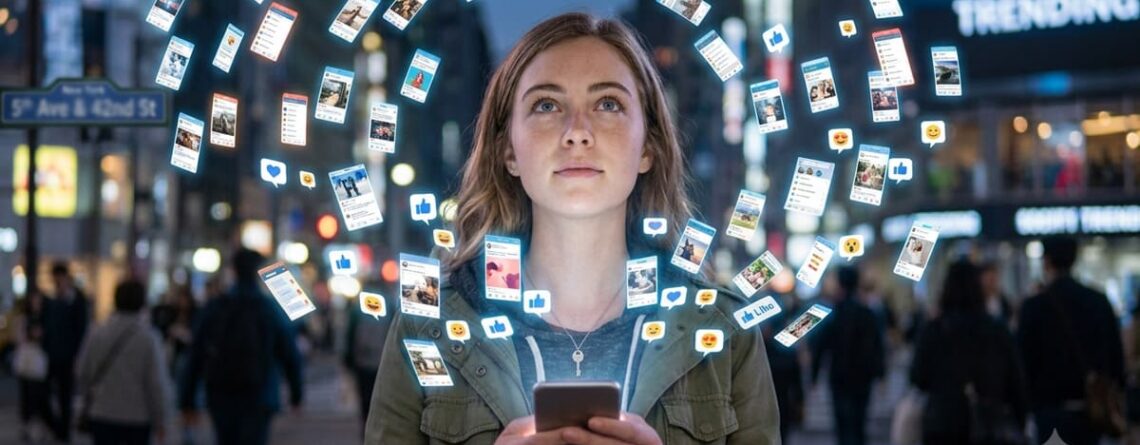
Can social media cause psychosis?
There is currently no established clinical diagnosis called “social media-induced psychosis,” and research has not shown that ordinary social-media use directly causes psychosis. However, emerging evidence suggests that digital environments may interact with existing vulnerability, social stress, sleep disruption, misinformation, interpersonal sensitivity, and problematic patterns of engagement. For someone already at elevated risk, certain online experiences may reinforce suspicious or unusual beliefs. At the same time, social media can also provide connection, information, and support.
When an Online Experience Stops Feeling Like “Just Content”
Social media is designed to make information feel relevant. A post appears because an algorithm selected it, someone responds directly to a comment, a video follows another video with a similar theme, and notifications repeatedly draw attention back to the same digital environment. Most of the time, the brain interprets these events for what they are: interactions produced by people, platforms, and recommendation systems. Even when a feed feels unusually personalized, users generally understand that personalization is being generated by software and previous patterns of engagement.
For someone experiencing psychosis, however, interpreting what is happening around them can become much more difficult. Psychosis involves a loss of contact with aspects of shared reality and may include delusions, hallucinations, disorganized thinking, or difficulty distinguishing what is real from what is not. It can occur in several psychiatric or medical conditions and is not synonymous with schizophrenia. The digital environment introduces an additional layer because online events can be unusually repetitive, personalized, and socially ambiguous. That raises an important question for modern mental-health research which is could an environment built around constant information and social feedback become particularly difficult to navigate when reality testing is already under strain?
“Social Media-Induced Psychosis” Is a Useful Phrase, but Not a Diagnosis
The phrase social media-induced psychosis is increasingly used online to describe psychotic experiences that appear to emerge around intense digital-media exposure. Clinically, however, it needs to be used cautiously. Psychosis can have many contributing factors, including genetic vulnerability, brain and developmental factors, severe stress, sleep disruption, substance exposure, and underlying psychiatric or medical conditions. Social media may interact with some of these factors, but researchers have not established a single pathway in which using TikTok, Instagram, YouTube, or another platform directly produces a psychotic disorder.
Recent research reinforces the need for that distinction. A 2026 systematic review examining social media in early psychosis and first-episode psychosis identified only nine eligible studies from 436 records and concluded that the relationship was complex and heterogeneous. The review identified possible roles for social stress, misinformation, and heightened interpersonal sensitivity, but it also found potentially protective effects, including social support and normalization of experiences. The evidence therefore does not support reducing the issue to a simple formula of more social media = more psychosis.
The Digital Feedback Loop: When Personalization Meets a Vulnerable Mind
One possible pathway involves what can be described as a digital feedback loop. Recommendation systems are designed to identify material that is likely to keep users engaged. When someone repeatedly watches, searches for, comments on, or interacts with a particular type of content, the platform may respond by presenting more related material. To most users, this simply feels like an increasingly specialized feed. But if someone is already experiencing unusual or paranoid beliefs, repeated exposure to similar information may become part of the way they interpret what is happening around them.
The algorithm does not have to “know” what the person is thinking for this experience to develop. Personalization can create an environment in which similar topics appear repeatedly, while the person’s interpretation of those topics is simultaneously changing. A series of related videos, comments, advertisements, or apparently coincidental references may therefore feel personally meaningful even when they have ordinary technological explanations. Research has proposed social stress, misinformation, and interpersonal sensitivity as possible pathways connecting digital environments with psychosis vulnerability, but the evidence remains insufficient to conclude that algorithms themselves create delusions.
Why Algorithms Can Feel More Personal Than They Actually Are
The human brain is naturally sensitive to patterns and significance. This ability is fundamental to learning because it allows us to identify relationships between events, anticipate what might happen next, and make decisions based on previous experience. In psychosis, however, this ordinary pattern-detection process can become distorted. Neutral or unrelated events may acquire unusually strong personal meaning, and a belief can become increasingly resistant to evidence that contradicts it.
A personalized digital feed can unintentionally make this process more difficult to interpret because it repeatedly presents material that resembles what the user has already viewed. What appears to be an improbable coincidence may actually be the predictable result of recommendation technology. Understanding that distinction is an important part of digital literacy. A personalized feed is not evidence that a platform is secretly communicating a message to an individual. At the same time, simply telling someone experiencing psychosis that “the algorithm did it” may not address the underlying clinical problem. The interpretation itself requires compassionate attention.
AI Changes the Equation Again
Generative artificial intelligence introduces another layer because conversational systems can respond directly to a person’s interpretation of events. A conventional social-media post is something a user reads, watches, or responds to, whereas an AI chatbot can engage in an extended conversation that appears highly personalized. This creates a potential concern when a person is expressing a strongly held but implausible belief: if the system simply mirrors the person’s assumptions rather than introducing appropriate uncertainty or encouraging professional support, the conversation could make the belief feel more coherent.
Emerging case evidence illustrates why this issue deserves attention, although it does not establish causation. A 2025 case report described new-onset psychosis involving immersive AI chatbot use in a person whose chatbot conversations reportedly validated and reinforced delusional thinking. The person’s symptoms improved following hospitalization and treatment, but later recurred in the context of renewed stimulant exposure, medication discontinuation, and continued immersive chatbot use. A single case cannot demonstrate that AI caused psychosis, but it highlights a new digital-wellness concern, “AI systems need to avoid reinforcing potentially dangerous or reality-distorting beliefs.”
The Warning Signs May Appear Beyond the Screen
Psychosis is not identified simply by spending many hours online, following unusual accounts, or believing something strange after seeing it on social media. The concern becomes greater when there is a broader change in thinking, perception, behaviour, or everyday functioning. Possible warning signs include increasing suspiciousness or paranoia, unusual or intensely held ideas, confused communication, social withdrawal, major sleep disruption, difficulty distinguishing reality from fantasy, and a decline in school, work, or interpersonal functioning.
In a digital context, a family might notice that someone has become increasingly convinced that posts, advertisements, videos, strangers, or online conversations are communicating directly with them. They may repeatedly search for information that confirms the belief, become frightened by ordinary online interactions, or change their behaviour dramatically because of what they believe is happening online. One unusual belief by itself does not establish psychosis; clinicians consider the pattern, intensity, persistence, associated symptoms, and effect on daily life.
Teens and Young Adults Deserve Particular Attention
Psychosis can occur at any age, but it frequently emerges during adolescence or young adulthood. This is also a period in which social relationships, identity, independence, sleep patterns, and online behaviour are changing rapidly. NIMH notes that psychosis often begins in the late teens through the mid-20s, while schizophrenia is commonly diagnosed between ages 16 and 30 following a first psychotic episode. This overlap makes digital experiences worth considering when evaluating a young person’s changing mental health, but it does not mean that social-media use causes psychosis.
What matters most is a significant change from the person’s previous functioning. A sudden decline in academic or occupational performance, increasing isolation, severe sleep disruption, unusual beliefs, confused speech, or dramatic behavioural changes deserve attention whether or not social media is involved. Digital activity can be part of the clinical history, but it should not become the sole explanation for a complex change in mental health.
What Families Can Do Without Turning the Phone Into the Enemy
When a family becomes frightened by what someone is saying or believing online, the immediate instinct may be to confiscate the phone or eliminate social media altogether. That response can sometimes increase conflict, secrecy, and isolation, particularly if the person already feels misunderstood or threatened. A more constructive starting point is to listen calmly and understand what the individual is experiencing. Families can ask what they have seen online, what they believe it means, and whether those experiences are making them frightened, suspicious, or unable to sleep.
The goal is not to argue aggressively about whether the person’s belief is “crazy,” but it is equally important not to reinforce an implausible belief simply to avoid conflict. A family member can acknowledge the person’s distress without confirming the interpretation for example, recognizing that the experience feels frightening while remaining uncertain about whether the perceived message is actually there. If unusual beliefs, hallucinations, severe confusion, or major functional changes are persistent or worsening, professional mental-health assessment should take priority over attempts to manage the situation through social-media restrictions alone.
Digital Boundaries Should Reduce Stimulation Not Become Another Punishment
A healthier digital strategy may involve reducing highly stimulating or distressing content, taking structured breaks, restoring regular sleep, and creating predictable periods of offline activity. These steps can be useful components of a broader routine, particularly when late-night scrolling, distressing content, online conflict, or compulsive checking is interfering with sleep and emotional stability.
For someone experiencing psychotic symptoms, however, digital boundaries should ideally be incorporated into an individualized care plan rather than treated as a standalone cure. The objective is not necessarily to eliminate technology from the person’s life. Instead, the focus should be on identifying which digital experiences increase distress or confusion while preserving healthy sources of connection, information, and support.
What Recovery Looks Like in the Digital Age
Recovery from psychosis is not simply a matter of “getting offline.” Depending on the individual’s circumstances, effective care can include psychiatric treatment, psychological and psychosocial interventions, family education, supported education or employment, and coordinated specialty care. NIMH’s RAISE research found that coordinated specialty care produced better outcomes than typical care for people experiencing early psychosis, including improvements in symptoms, relationships, and quality of life.
Digital habits can be addressed within that broader recovery process. A clinician may help identify whether specific online environments worsen suspiciousness, sleep disruption, social withdrawal, emotional distress, or compulsive behaviour. The more useful question is therefore not “How do we get this person off social media?” but “How can we create a safer relationship with technology while addressing the underlying clinical problem?”
Social Media Can Also Be Part of the Support System
It would be misleading to portray digital platforms only as harmful. People experiencing psychosis may use online communities to reduce isolation, maintain relationships, find peer support, or learn about mental health. A 2026 systematic review of social media and schizophrenia-spectrum disorders found some evidence suggesting that social-media use can be associated with better functioning and fewer negative symptoms, although the researchers emphasized that most available studies were cross-sectional and carried moderate-to-high risk of bias.
This creates an important paradox: the same digital environment can be supportive for one person and destabilizing for another, or even play different roles for the same person at different stages of illness. Consequently, researchers are increasingly interested not simply in how much social media someone uses, but how they use it, why they use it, what they encounter, and what happens afterward. Hours of screen time alone cannot capture that complexity.
A Documented Digital-Age Example: When an AI Conversation Reinforced a Belief
A 2025 case report involving immersive AI chatbot use provides a useful cautionary example rather than proof of causation. The individual developed delusional thinking in the context of intensive chatbot interactions in which the system reportedly validated and reinforced unusual interpretations. Following hospitalization and treatment, the delusional beliefs resolved, although symptoms later returned in the context of medication discontinuation, renewed stimulant exposure, and continued immersive chatbot use.
The case is valuable because it illustrates how the interaction itself may matter. Unlike passive scrolling, a conversational AI system can respond to a person’s ideas repeatedly, elaborate on them, and create the impression of an ongoing interpersonal exchange. That possibility deserves further research, particularly around AI “sycophancy,” emotional dependence, reality-testing safeguards, and how systems should respond when users express potentially delusional beliefs. At present, however, the evidence is too limited to conclude that AI chatbots cause psychosis.
What Researchers Still Don’t Know
The science is developing rapidly, but several major questions remain unanswered. Most existing studies cannot determine whether social-media exposure contributes to psychosis, whether people experiencing emerging symptoms simply turn toward social media more heavily, or whether both processes occur simultaneously. The 2026 systematic review of early psychosis specifically noted the predominance of correlational evidence and the scarcity of longitudinal and qualitative research.
Researchers also need better ways to distinguish between very different types of digital engagement. Passive scrolling, supportive conversations, hostile interactions, exposure to conspiracy content, compulsive checking, online harassment, and immersive AI conversations are not psychologically equivalent experiences. Future studies will therefore need to examine the quality and context of digital engagement, rather than treating all social-media use as one exposure.
Recent Research Highlights
A 2026 systematic review of social media in early psychosis and first-episode psychosis examined 436 records and identified only nine eligible studies. Its findings emphasized a heterogeneous relationship in which social stress, misinformation, and interpersonal sensitivity may contribute to vulnerability, while social connection and normalization of experiences may sometimes be protective. The authors highlighted the need for more longitudinal research before firm causal conclusions can be drawn.
A separate 2026 systematic review examining social media and schizophrenia-spectrum disorders similarly found that much of the literature remains cross-sectional and carries moderate-to-high risk of bias. The findings did not demonstrate that greater social-media use universally increases positive psychotic symptoms and instead pointed toward a more complicated relationship involving the type and context of engagement.
Research is also beginning to explore whether language patterns in social-media posts could help identify psychosis-related changes. Natural-language processing may eventually contribute to earlier identification, but current approaches have important limitations involving validation, privacy, ethics, generalizability, and the risk of incorrectly labelling people based on their language.
Recent Clinical Studies & Surveys
There is currently no clinical trial demonstrating that reducing social-media use treats psychosis. The strongest clinical evidence instead supports early identification and evidence-based treatment of psychosis itself. NIMH emphasizes the importance of reducing the duration of untreated psychosis and identifies coordinated specialty care as an evidence-supported approach for people experiencing an early psychotic episode.
Treatment may include antipsychotic medication alongside psychological, psychosocial, family-based, educational, and vocational interventions, depending on the individual’s circumstances. Digital interventions may eventually become useful additions to monitoring, early detection, psychoeducation, or support, but researchers still need to establish reliable and ethically appropriate ways to use these technologies in clinical settings.
Key Takeaways
- “Social media-induced psychosis” is not an established psychiatric diagnosis.
- Current research does not establish that ordinary social-media use directly causes psychosis.
- Digital environments may interact with vulnerability, stress, sleep disruption, misinformation, and unusual interpretations.
- Recommendation algorithms can repeatedly expose users to similar material without intentionally sending them a personal message.
- AI introduces an additional concern because conversational systems can potentially mirror or reinforce a person’s interpretation of events.
- Psychosis can involve delusions, hallucinations, disorganized thinking, and difficulty distinguishing reality from fantasy.
- Warning signs can include paranoia, social withdrawal, severe sleep disruption, unusual beliefs, confused communication, and declining everyday functioning.
- Teens and young adults deserve particular attention because psychosis commonly emerges during this developmental period.
- Screen time alone is a poor measure of digital mental-health risk.
- Social media is not universally harmful and can also provide connection and peer support.
- Persistent or worsening psychotic symptoms require professional assessment rather than simply a digital detox.
- Digital wellness should focus on the quality, meaning, and consequences of online experiences, not simply the number of hours spent online.
FAQ (Frequently Asked Questions)
-
Can social media cause psychosis?
Current evidence does not establish that ordinary social-media use directly causes psychosis. Research suggests that digital environments may interact with existing vulnerabilities, psychosocial stress, sleep disruption, and other factors. -
What does “social media-induced psychosis” mean?
It is an informal phrase used to describe psychotic experiences that appear connected to intense or distressing digital experiences. It is not currently a formal psychiatric diagnosis. -
Can algorithms make delusions worse?
Algorithms may repeatedly expose someone to similar content based on their previous engagement. For someone already experiencing unusual or paranoid beliefs, this repetition could potentially reinforce their interpretation, but direct causal evidence remains limited. -
Can AI chatbots contribute to delusional thinking?
Emerging case reports raise this possibility, particularly when conversational systems repeatedly validate unusual beliefs. However, case reports cannot establish that chatbot use caused psychosis. -
What are early warning signs of psychosis?
Possible signs include increasing suspiciousness, unusual beliefs, social withdrawal, confused communication, major sleep disruption, difficulty distinguishing reality from fantasy, and declining functioning. -
Are teenagers more vulnerable to psychosis?
Psychosis commonly begins during adolescence or young adulthood, although it can occur at any age. This does not mean that social-media use makes teenagers psychotic. -
Should someone experiencing psychosis stop using social media completely?
Not necessarily. A healthcare professional can help determine whether particular digital activities are worsening symptoms. Social connection and peer support can also be valuable. -
Is spending too much time online a sign of psychosis?
No. Heavy social-media use alone does not indicate psychosis. The concern is whether there are broader changes in reality testing, thinking, perception, behaviour, or functioning. -
Can sleep disruption make things worse?
Severe sleep disruption can accompany mental-health difficulties and may worsen psychological distress. Persistent sleep disruption alongside unusual beliefs, perceptions, or major behavioural changes warrants professional attention. -
Can psychosis be treated?
Yes. Effective treatments are available, and early treatment is associated with better recovery. Treatment may involve medication, psychological and psychosocial interventions, family support, and coordinated specialty care. -
Can social media ever help someone with psychosis?
Yes. Online communities can provide social connection, peer support, and information. Research does not support treating all social-media use as inherently harmful. -
What should a family do if someone believes social media is sending them secret messages?
Families should avoid escalating confrontation or reinforcing the belief. Listening calmly, acknowledging the person’s distress without confirming the interpretation, and seeking professional mental-health assessment are more appropriate steps, particularly when the belief is persistent, intensifying, or affecting safety and daily functioning.
DISCLAIMER: The content of this article is intended solely for general informational purposes and is not a substitute for professional medical consultation, diagnosis, or treatment. Always seek the advice of your doctor or another qualified healthcare professional regarding any medical concerns.