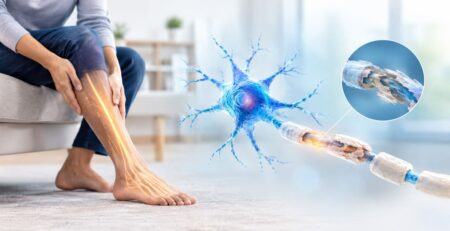
Parkinson’s Disease is a progressive neurological disorder that affects brain circuits involved in movement, cognition, mood, sleep and automatic body functions. The familiar tremor is only one possible symptom. Loss of dopamine-producing neurons in the substantia nigra disrupts basal-ganglia circuits responsible for smooth movement, while changes in other brain systems contribute to problems such as slowed thinking, sleep disturbances, depression, fatigue and autonomic symptoms.
Is Parkinson’s Really Just About the Tremor?
Parkinson’s disease is often introduced with a single image: a hand that trembles. But the tremor is only one piece of a much larger neurological story. Parkinson’s can affect how quickly someone moves, how they walk, how they sleep, how they regulate blood pressure, how they speak and swallow, and particularly as the disease progresses; how they think and manage complex tasks.
The deeper question is therefore not simply “Why does Parkinson’s cause shaking?”
It is:
What happens when a disease gradually changes the brain networks responsible for movement, thinking and automatic body functions?
Understanding that bigger picture can change how Parkinson’s is recognized, assessed and managed.
What Is Happening Inside the Parkinsonian Brain?
Parkinson’s disease develops when nerve cells become impaired and die in several brain regions. One of the most important areas is the substantia nigra, where neurons normally produce dopamine. Dopamine acts as a chemical messenger within circuits connecting the substantia nigra with the basal ganglia, a group of structures involved in selecting, initiating and smoothly controlling movement.
As dopamine-producing neurons are lost, these circuits become abnormally regulated. The result can be bradykinesia (slowness of movement), rigidity, resting tremor and postural or gait problems. By the time typical motor symptoms become apparent, substantial loss of dopamine-producing neurons has usually already occurred. But dopamine is not the entire story.
Parkinson’s also involves other neurotransmitter systems, including pathways involving norepinephrine and acetylcholine, helping explain why symptoms can extend far beyond movement. Abnormal accumulation of the protein alpha-synuclein is another important feature of Parkinson’s and related disorders.
Beyond the Tremor: The Four Better-Known Motor Symptoms
The classic motor features include:
- Tremor: Often begins at rest and may affect one hand, although not everyone with Parkinson’s develops a prominent tremor.
- Bradykinesia: Movements become slower and may require greater conscious effort.
- Rigidity: Muscles can feel stiff or resistant to movement.
- Postural and gait problems: Balance, walking and turning may become increasingly difficult.
A person may also develop shuffling steps, reduced arm swing, difficulty initiating movement or freezing of gait, in which the feet temporarily seem unable to move forward. This is why Parkinson’s should not be reduced to “the shaking disease.” Some people have little or no tremor, while other symptoms may become more disruptive than the tremor itself.
The Hidden Side of Parkinson’s: Non-Motor Symptoms
Some of Parkinson’s most important symptoms are not visible. They may include:
- Sleep disturbance and REM sleep behaviour disorder
- Depression and anxiety
- Fatigue
- Constipation
- Changes in smell
- Blood-pressure regulation problems
- Pain
- Swallowing difficulties
- Urinary or sexual problems
- Cognitive changes
Some non-motor symptoms can appear before obvious movement problems. Sleep disturbances, loss of smell and mood changes can therefore provide important clinical clues, although none of these symptoms alone proves that someone has Parkinson’s. This is one of the most important misconceptions to correct:
Parkinson’s is not exclusively a movement disorder.
How Parkinson’s Can Affect Thinking
Cognitive changes are highly variable. Some people maintain relatively strong memory and thinking throughout much of the disease. Others develop difficulties with attention, planning, mental flexibility, processing speed or visuospatial abilities. The pattern can sometimes feel different from ordinary forgetfulness.
A person might:
- Take longer to organize a complicated task.
- Lose track during a multi-step activity.
- Find it harder to switch between tasks.
- Need more time to retrieve information.
- Struggle with planning or problem-solving.
- Have difficulty judging distances or navigating spaces.
These problems can reflect changes in brain networks involving the frontostriatal circuits and prefrontal cortex, rather than simply a failure of memory storage. Research continues to investigate how dopamine, acetylcholine, alpha-synuclein and altered neural rhythms interact within these networks.
Parkinson’s Dementia Is Not the Same as Ordinary Forgetfulness
Cognitive impairment exists on a spectrum. Some people develop mild cognitive impairment that does not substantially interfere with independence. In others, cognitive changes eventually become severe enough to interfere with everyday functioning, which can meet criteria for Parkinson’s disease dementia.
Importantly, not everyone with Parkinson’s develops dementia. When dementia occurs, difficulties may involve attention, executive function, memory, language, reasoning and visuospatial abilities. Timing also matters clinically: Parkinson’s disease dementia refers to dementia developing in the setting of established Parkinsonian motor disease, whereas dementia with Lewy bodies generally presents with cognitive symptoms before or around the emergence of parkinsonism.
Why Can the Same Disease Affect Movement and Thinking?
Movement and cognition may appear unrelated, but the brain networks supporting them are deeply interconnected. The basal ganglia, thalamus and frontal regions form several parallel circuits. Some are heavily involved in movement; others contribute to motivation, planning, attention and decision-making.
Parkinson’s can disrupt these interconnected networks. That helps explain why the same underlying disease can produce a combination of slowness of movement and slowness of thought, while also affecting mood, sleep and automatic functions.
Causes and Risk Factors
There is no single cause of most Parkinson’s cases. Researchers believe Parkinson’s usually reflects an interaction between genetic susceptibility and environmental or biological factors. A smaller proportion of cases can be linked to identifiable genetic variants. Age is an important risk factor, but Parkinson’s is not an inevitable part of aging.
Scientists are also investigating mechanisms involving mitochondrial dysfunction, oxidative stress, neuroinflammation, impaired protein handling and abnormal alpha-synuclein aggregation. These mechanisms are important areas of research, but no single mechanism currently explains every case.
A Real-World Perspective
Michael S. Citrin’s experience shows why Parkinson’s cannot be reduced to a story about tremors. He was a person whose story was published by the Parkinson’s Foundation as part of its “My PD Story” series. He lived with Parkinson’s disease for more than 30 years and shared his experience to help others understand what living with the condition can be like. He first noticed a tremor in his arm, but it took more than eight years and several specialist visits before his symptoms were confirmed as Parkinson’s disease. His journey also highlights how differently the condition can affect people and how managing Parkinson’s may involve adapting treatment, staying physically active, addressing emotional challenges and finding ways to maintain independence and purpose.
According to the Parkinson’s Foundation:
- He first noticed a tremor in his arm while participating in a fox hunt.
- It took more than eight years and several specialist visits before his symptoms were confirmed as Parkinson’s disease.
- He focused on managing the condition through treatment, exercise, mental stimulation and maintaining an active life.
- He continued activities including travel, motorcycle riding and singing in a church choir.
- He also wrote a self-help guide based on his experience, titled Thirty Years with Parkinson’s Disease: The Unscientific Truth.
Michael Citrin died on August 9, 2026, from complications associated with Parkinson’s disease. His long journey illustrates the highly individual nature of Parkinson’s and the importance of adapting to changes while maintaining treatment, activity and quality of life.
How Is Parkinson’s Diagnosed?
There is currently no single routine blood test that establishes Parkinson’s disease. Diagnosis remains primarily clinical. A neurologist assesses the history and performs a neurological examination, looking for parkinsonism, particularly bradykinesia combined with rest tremor or rigidity and then considers supportive features, exclusion criteria and warning signs for alternative diagnoses.
Cognitive assessment may also be appropriate when changes in attention, memory, planning or everyday functioning are reported. The Movement Disorder Society’s non-motor assessment tools can systematically evaluate symptoms across multiple domains, while cognitive testing can help identify and monitor cognitive impairment.
Treatment Is More Than Medication
Treatment is individualized and may combine medication, rehabilitation and lifestyle approaches.
Established management can include:
- Medication to improve dopamine-related motor symptoms.
- Physical therapy for walking, balance and mobility.
- Occupational therapy for everyday activities.
- Speech and swallowing therapy when needed.
- Exercise and physical activity.
- Management of sleep, mood, pain and autonomic symptoms.
- Cognitive and behavioural support where appropriate.
- Deep brain stimulation for carefully selected patients.
Deep brain stimulation works by delivering electrical stimulation to specific movement-related brain circuits and can improve certain motor symptoms in appropriately selected people. Treatment decisions should always be individualized by the appropriate clinical team.
Exercise: One of the Most Practical Brain-and-Body Tools
Exercise has become an increasingly important part of Parkinson’s management. Updated 2026 Parkinson’s Foundation and American College of Sports Medicine recommendations emphasize four major domains:
- Aerobic activity
- Strength training
- Flexibility
- Balance, agility and multitasking
The recommendations emphasize adapting exercise to the person’s abilities, disease stage, medication status, safety and other health conditions. Exercise should not be presented as a cure. However, regular appropriately prescribed activity can support mobility, balance, physical function and quality of life.
Neuroplasticity: Can the Brain Adapt?
The brain is capable of adapting its activity and connections in response to practice and experience. This is relevant to rehabilitation in Parkinson’s. Repeated movement practice, external cues and task-specific training can help people develop strategies for movement when automatic motor control becomes more difficult.
But neuroplasticity does not mean “rewiring Parkinson’s away.”
Human research supports the brain’s capacity for adaptation and compensation, but it does not establish that brain-training or exercise can reverse the underlying neurodegeneration. That distinction is essential for responsible cognitive-health communication.
Recent Research Highlights: Looking for Parkinson’s Beyond Symptoms
One of the most interesting developments is the search for biological biomarkers that could complement clinical diagnosis. A 2025 systematic review and meta-analysis evaluated skin alpha-synuclein assays. Across studies distinguishing Parkinson’s from healthy or non-neurodegenerative controls, pooled sensitivity was approximately 78% and specificity 96%; seed amplification assays performed better than some other techniques. However, distinguishing Parkinson’s from other synucleinopathies such as multiple system atrophy remained difficult.
A separate 2024 diagnostic study tested a modified skin alpha-synuclein seed-amplification assay in 332 people with Parkinson’s and 285 controls, reporting 92.46% sensitivity and 93.33% specificity within that study. These findings are exciting, but they are not yet a reason to treat a skin test as a universal diagnostic replacement. Differences between laboratories, populations, sampling methods and disease subtypes remain important limitations.
Recent Clinical Studies & Surveys
Cognitive symptoms are another active research area.
A systematic review and meta-analysis of 31 studies involving 3,441 people with Parkinson’s found that subjective cognitive complaints occurred in approximately 36% of participants. However, subjective complaints showed only weak relationships with objective cognitive performance in cross-sectional research, highlighting why formal cognitive assessment can sometimes provide information that a person’s own perception does not.
This is a useful clinical lesson:
Feeling that your memory is worse and demonstrating measurable cognitive impairment are related, but they are not identical.
Longitudinal studies are therefore particularly important for understanding who develops persistent cognitive impairment and how it changes over time.
Living With Parkinson’s: Think Beyond Symptoms
Long-term management works best when it considers the whole person.
Useful areas to monitor include:
- Movement and balance
- Sleep quality
- Mood and emotional wellbeing
- Cognitive changes
- Speech and swallowing
- Physical activity
- Nutrition and hydration
- Social participation
- Medication effects
- Falls and safety
- Caregiver needs
Keeping track of changes over time can help clinicians distinguish a temporary fluctuation from a broader pattern.
Why Looking Beyond, the Tremor Matters
A tremor is visible. Changes in attention, sleep, motivation, planning or processing speed may not be. That difference can lead people to underestimate the neurological impact of Parkinson’s.
Looking beyond the tremor creates a more complete picture: Parkinson’s is a disorder of interconnected brain systems, not simply a problem with shaking hands. Understanding that broader picture can encourage earlier attention to non-motor symptoms, more comprehensive assessment and a management plan that addresses both how the person moves and how the person thinks, sleeps, feels and functions.
Key Takeaways
- Parkinson’s is much more than a tremor disorder.
- Loss of dopamine-producing neurons in the substantia nigra disrupts movement-related brain circuits.
- Bradykinesia, rigidity, tremor and gait/balance problems are major motor features.
- Sleep, mood, autonomic function, smell, fatigue, pain and cognition can also be affected.
- Cognitive changes may involve attention, executive function, processing speed and visuospatial abilities not just memory.
- Not everyone with Parkinson’s develops dementia.
- Exercise and rehabilitation are important components of comprehensive management.
- Biomarker research involving alpha-synuclein is promising but remains an evolving field.
- Long-term monitoring can help capture changes that a single appointment may miss.
- Parkinson’s care works best when movement, cognition and overall wellbeing are considered together.
FAQ (Frequently Asked Questions)
-
Does everyone with Parkinson’s have tremors?
No. Tremor is common, but some people with Parkinson’s have little or no tremor. Slowness and rigidity can be more prominent. -
What part of the brain is affected by Parkinson’s?
The substantia nigra is particularly important because it contains dopamine-producing neurons involved in movement circuits. Parkinson’s also affects other brain systems. -
Can Parkinson’s affect memory?
Yes, but cognitive changes vary considerably. Attention, executive function, processing speed and visuospatial abilities may be affected, sometimes before significant memory impairment. -
Does Parkinson’s always lead to dementia?
No. Some people experience relatively preserved cognition for many years, while others develop mild cognitive impairment or Parkinson’s disease dementia. -
What is Parkinson’s disease dementia?
It refers to cognitive impairment that develops in the context of established Parkinson’s disease and becomes severe enough to interfere substantially with everyday functioning. -
Can Parkinson’s cause depression or anxiety?
Yes. Mood symptoms can occur during Parkinson’s and may sometimes appear relatively early in the disease. -
Can exercise help Parkinson’s?
Exercise can help support mobility, balance, strength, flexibility and quality of life. Current recommendations emphasize individualized aerobic, strength, flexibility and balance/agility training. -
Is there a test that definitively diagnoses Parkinson’s?
Diagnosis is primarily clinical. Emerging biomarkers, including alpha-synuclein assays, are promising but are not a universal replacement for neurological assessment. -
What is alpha-synuclein?
Alpha-synuclein is a protein associated with Parkinson’s and related synuclein disorders. Abnormal aggregation of the protein is an important feature of these diseases. -
Can brain training cure Parkinson’s?
No. Cognitive activities may support mental engagement, but there is no evidence that brain training cures or reverses the underlying neurodegeneration. -
When should cognitive changes be discussed with a doctor?
New or progressively worsening problems with attention, memory, planning, judgment or everyday functioning should be discussed with a healthcare professional, particularly in someone with Parkinson’s. -
Why is Parkinson’s called more than a movement disorder?
Because it can affect multiple systems involved in cognition, mood, sleep, autonomic function, sensation and behaviour in addition to movement.
DISCLAIMER: The content of this article is intended solely for general informational purposes and is not a substitute for professional medical consultation, diagnosis, or treatment. Always seek the advice of your doctor or another qualified healthcare professional regarding any medical concerns.