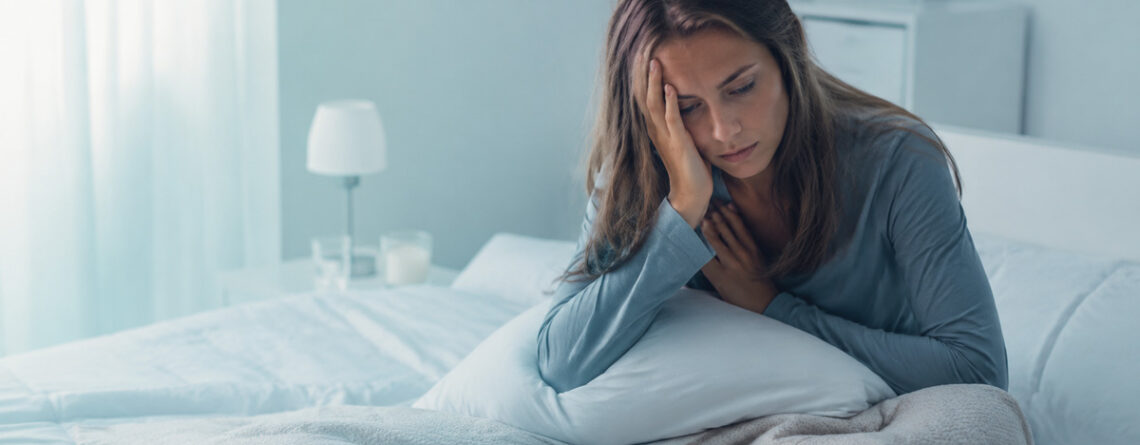
Why Anxiety Rises In The Dark? Understanding Midnight Anxiety
The room is quiet. The lights are off. The day is finally over — yet your mind suddenly turns loud.
Instead of settling down, you start replaying conversations, worrying about tomorrow, and noticing every little sensation in your body. A concern that seemed manageable at 3 p.m. can feel urgent at midnight.
This is often called midnight anxiety, nighttime anxiety, or pre-sleep anxiety. It is not a formal diagnosis. It simply describes anxiety that shows up or feels stronger in the evening, at bedtime, or after waking during the night.
Anxiety itself is a normal human response to uncertainty or possible danger. An anxiety disorder is different: the fear or worry becomes persistent, hard to control, widespread, or disruptive to daily life.
Why Anxiety Feels Stronger At Night
Anxiety can feel worse in the dark because nighttime combines several stress-amplifying conditions at once: less sensory information, more uncertainty, fewer distractions, mental fatigue, sleep-related worry, and changes in emotional regulation.
Darkness may heighten vigilance, but it is rarely the only reason. For many people, the real trigger is the full nighttime setting — silence, isolation, tiredness, unfinished concerns, and pressure to fall asleep.
Research suggests that fear responses can be stronger at night, although the relationship between darkness, biological timing, and anxiety is complex. It would be inaccurate to say darkness automatically causes anxiety in everyone.
Key Takeaways
- Darkness can increase uncertainty because there is less visual information.
- Nighttime anxiety is influenced by more than lighting alone.
- Fatigue and sleep loss can make emotions harder to regulate.
- Reduced daytime stimulation gives unresolved worries more room to grow.
- Worry about not sleeping can keep the brain alert.
- Repeatedly checking the time can make pre-sleep worry worse.
- Panic attacks can sometimes happen during sleep.
- Tracking patterns over time is often more useful than focusing on one bad night.
- Persistent or worsening nighttime anxiety should be discussed with a qualified healthcare professional.
Is It The Darkness Or The Nighttime?
Darkness and nighttime usually happen together, but they are not the same psychologically.
Darkness reduces visual information. Nighttime also brings biological timing, fatigue, changes in routine, social quiet, and the expectation of sleep.
An experimental study that looked at both lighting and time of day found stronger fear responses during nighttime conditions. Its findings suggested that biological day-night timing may matter independently of whether the room is physically dark.
A 2026 laboratory study of 87 healthy young adults found partial evidence that attention to certain ambiguous threats may be stronger at night. But the results varied by threat type and anxiety level, so the study does not support the simple idea that every person becomes more fearful after dark.
The more accurate explanation is simple: darkness may remove reassuring information, while nighttime adds fatigue, internal focus, and biological context.
Why The Brain Worries More
- Darkness gives the brain less to work with
During the day, the environment gives you constant visual clues. You can quickly tell where a sound came from, whether a shadow is harmless, whether a door is closed, or whether someone is nearby. In darkness, those details become less certain.
The brain does not stop trying to interpret the world when information is incomplete. Instead, it starts predicting what might be there. If you are already anxious, those predictions may tilt toward danger.
Experimental studies have found that darkness can increase startle responses in simulated environments. That supports the idea that darkness can act as a context for increased vigilance, although a lab startle response is not the same as an anxiety disorder.
The overlooked issue is ambiguity.
People often think they fear a specific thing in the dark. In many cases, the deeper trigger is not knowing.
That uncertainty invites questions like:
- What was that noise?
- Did I lock the door?
- Is that sensation in my chest dangerous?
- What if I cannot sleep?
- What if tomorrow goes badly?
Anxiety often treats uncertainty like a problem that must be solved immediately. At midnight, though, many of those concerns cannot be solved at all. The brain keeps searching for certainty even when no useful answer exists.
- Your internal clock matters too
The body follows roughly 24-hour rhythms that regulate sleep, wakefulness, and other biological functions. The brain’s central circadian clock helps signal when the body should be awake and when it should prepare for sleep.
That does not mean everyone has a predictable “anxiety hour.” People differ in:
- Chronotype.
- Sleep schedule.
- Work schedule.
- Light exposure.
- Mental-health history.
- Medication use.
- Health conditions.
- Daily stress.
Research has found that anxiety symptoms can vary by time of day and chronotype. A 2024 study reported higher evening anxiety among participants with an evening chronotype, especially in the evening hours. That was an association, not proof that being a night owl directly causes anxiety.
Circadian disruption is also associated with mental-health difficulties, but the relationship may go both ways: disrupted rhythms may affect emotional health, and anxiety may disrupt sleep and daily rhythms.
- Fatigue weakens emotional regulation
By the end of the day, the brain has already spent hours:
- Making decisions.
- Managing interruptions.
- Regulating emotions.
- Switching between tasks.
- Filtering irrelevant information.
- Responding to social demands.
When people are tired or sleep-deprived, their ability to evaluate emotional information calmly can drop. Brain-imaging research has shown that sleep deprivation can increase emotional reactivity and weaken communication between prefrontal regulatory regions and the amygdala, a brain structure involved in processing emotionally important information.
Sleep loss has also been shown to amplify anticipatory responses in brain regions involved in anxiety, especially in people with higher trait anxiety.
A meta-analysis found that acute sleep deprivation increased state anxiety. Partial or chronic sleep restriction may affect people differently. That helps explain why a thought can feel more threatening late at night than it did earlier.
The thought may not have changed. Your ability to regulate it may have.
- When the day gets quiet, thoughts get louder
During the day, attention is pulled in many directions:
- Work.
- Conversation.
- Travel.
- Notifications.
- Household tasks.
- Caregiving.
- Entertainment.
- Problem-solving.
At night, most of that stimulation fades. The silence does not necessarily create new worries. It often just makes existing worries easier to hear.
Research on pre-sleep cognition shows that people with insomnia commonly experience more intrusive thoughts, worry, cognitive arousal, counterfactual thinking, and attempts to control unwanted thoughts.
Typical midnight thought patterns include:
- Replaying the past.
- Predicting the future.
- Trying to solve impossible questions.
The brain can mistake thinking about a problem for solving it. At midnight, repeated analysis often increases arousal without producing a useful answer.
- The pressure to sleep can become the problem
Sleep normally happens when wake-promoting activity decreases and sleep-promoting processes take over. Trying to force sleep usually does the opposite.
A person may start thinking:
- I must fall asleep now.
- I only have five hours left.
- Tomorrow will be ruined.
- Why am I still awake?
- Something is wrong with me.
These thoughts create emotional and physical arousal right when the body needs calm. This can create an anxiety-insomnia cycle:
- The person worries.
- Worry delays sleep.
- The person notices the delay.
- The delay feels like proof that something is wrong.
- Anxiety increases.
- More arousal makes sleep even harder.
Insomnia research describes this as cognitive and emotional hyperarousal. Worry, rumination, selective attention, and sleep-related beliefs can help keep the cycle going.
Sleep and anxiety can influence each other in both directions. Anxiety can interfere with sleep, while poor sleep can increase emotional dysregulation and vulnerability to more anxiety.
- The bed can become a signal for alertness
People learn associations between places and internal states.
Ideally, the bed becomes linked with sleep. But after repeated nights of worrying, checking the time, scrolling, working, or trying too hard to fall asleep, the bed may start to feel linked with:
- Frustration.
- Monitoring.
- Mental effort.
- Bodily vigilance.
- Fear of another bad night.
Eventually, anxiety may begin as soon as the person enters the bedroom before a worrying thought even appears. That does not mean the person is choosing anxiety. It means the brain has learned to expect wakefulness and struggle in that space.
This is one reason cognitive behavioural therapy for insomnia, or CBT-I, uses stimulus control. The goal is to rebuild the association between bed and sleep. NHLBI describes strategies such as going to bed when sleepy, leaving the bed when unable to sleep, and using the bed mainly for sleep.
- Clock-watching turns time into pressure
At night, a clock can start to feel like a countdown. A person sees 12:45 a.m. and calculates how much sleep remains. At 1:20 a.m., the number feels even worse. Every check feeds more worry.
In two experiments, people told to monitor the clock reported more pre-sleep worry and longer sleep-onset time than people who did not monitor it. Participants with insomnia also tended to overestimate how long they had been awake when watching the clock.
The clock does not create the anxiety itself. It can, however, turn uncertainty into a repeated performance review:
Am I asleep yet, and what happens if I am not?
- Physical sensations feel louder at night
In a quiet room, internal sensations can become more noticeable:
- Heartbeat.
- Breathing.
- Muscle tension.
- Stomach movement.
- Warmth.
- Tingling.
- Dizziness.
- Changes in swallowing.
A person who is anxious may monitor these sensations and read them as danger.
For example:
- The person notices a faster heartbeat.
- They wonder whether something is wrong.
- Anxiety rises.
- The heart beats even faster.
- The stronger sensation seems to confirm the fear.
NIMH describes panic attacks as sudden episodes of intense fear that may include a racing heart, sweating, trembling, breathing difficulty, dizziness, tingling, chest discomfort, or nausea. Panic attacks can happen at any time, including during sleep.
New or severe physical symptoms should not automatically be assumed to be anxiety. Chest pain, serious breathing difficulty, fainting, neurological symptoms, or other urgent concerns need proper medical attention.
Midnight Anxiety, Insomnia, And Panic Are Not The Same
Here’s how these experiences differ:
- Midnight anxiety: worry or fear becomes stronger at bedtime or during nighttime waking. It is not a formal diagnosis.
- Pre-sleep cognitive arousal: racing thoughts, planning, replaying events, or monitoring sleep. This is often linked to delayed sleep.
- Insomnia: difficulty falling asleep, staying asleep, or getting restorative sleep. Chronic insomnia requires a broader pattern over time.
- Nocturnal panic attack: sudden intense fear that arises during sleep and may occur without an obvious dream or trigger.
- Fear of darkness: distress linked specifically to darkness or what may be hidden. This may involve learned associations or a phobia.
- Medical symptoms at night: physical symptoms that appear or worsen overnight and may require medical evaluation when they are new, severe, or unexplained.
Chronic insomnia is generally defined clinically as persistent sleep difficulty at least three nights per week for at least three months, together with daytime impairment.
How Midnight Anxiety Affects Cognitive Wellness
Nighttime anxiety does not stay confined to the night. Poor or disrupted sleep may affect:
- Attention.
- Working memory.
- Mental flexibility.
- Reaction time.
- Emotional regulation.
- Decision-making.
- Ability to focus.
- Perception of effort.
The next day, that can create a new wave of worry:
- Why can’t I concentrate?
- Is something wrong with my memory?
- Why am I making mistakes?
- Will I be able to function today?
That may create a second feedback loop:
- Anxiety disrupts sleep.
- Poor sleep affects cognitive performance.
- Cognitive difficulty becomes another source of worry.
- Worry makes the next night harder.
Insufficient sleep can impair clear thinking and focus, while sleep loss can disrupt many emotional processes. A difficult cognitive day after poor sleep does not automatically mean permanent decline. Sleep, stress, illness, and emotional state all matter when interpreting performance.
What To Do When Anxiety Rises At Night
The aim is not to force yourself to stop feeling anxious. A more realistic goal is to reduce the conditions that keep the alarm turned on.
- Name what is happening
Use a neutral statement:
“My anxiety is stronger because it is late, I am tired, and my mind has fewer external tasks.”
That separates the experience from the conclusion that danger must be present. - Do one reasonable safety check
If appropriate, check practical concerns once:
- Lock the door.
- Turn off the appliance.
- Confirm the environment is physically safe.
- Address an immediate caregiving need.
Then stop repeating the check. Repeated checking can teach the brain that uncertainty is dangerous and reassurance must keep being renewed.
- Reduce clock monitoring
Turn the clock away or move your phone out of direct view. An alarm can still function without showing a countdown all night. Clock monitoring has been linked to greater pre-sleep worry and longer perceived sleep onset.
- Put unfinished thoughts somewhere else
Write down:
- The concern.
- The next practical action.
- When you will review it.
- What does not need to be solved tonight.
For example:
- Work deadline: List the first three tasks: 9:00 a.m.
- Medical concern: Contact the clinic: Tomorrow morning.
- Difficult conversation: Draft two key points: After breakfast.
- Household problem: Ask for help or arrange repair: During business hours.
The goal is not to solve the issue immediately. It is to show the brain the issue has been captured, not forgotten.
- Use light intentionally
A completely dark room helps many people sleep. But if total darkness itself causes strong fear, a low, steady night-light may be a temporary comfort measure.
Avoid repeatedly turning on bright overhead lights or using stimulating screens. NHLBI notes that light from televisions and electronic devices can interfere with the sleep-wake cycle. The aim is a predictable sense of safety without turning the room into daytime.
- Choose a quiet, non-demanding activity
If you cannot sleep, forcing yourself to stay in bed while getting more frustrated may strengthen the bed-anxiety link.
CBT-I stimulus-control guidance commonly includes getting out of bed when sleep is not happening and returning when sleepiness develops. The activity should be quiet and unstimulating, not productive or emotionally activating.
Examples include:
- Reading something calm.
- Listening to quiet audio.
- Sitting in a comfortable chair.
- Practicing a familiar relaxation exercise.
- Doing a simple repetitive task.
- Build a predictable wind-down
A regular sequence can tell the brain that problem-solving time is over.
A wind-down routine might include:
- Preparing for the next morning.
- Writing unfinished tasks down.
- Reducing stimulating content.
- Lowering environmental light.
- Doing a quiet activity.
- Going to bed when sleepy.
NHLBI recommends consistent sleep and wake times, a sleep-supportive bedroom, reduced late caffeine and alcohol, and a routine that supports relaxation.
- Do not turn one bad night into a catastrophe
One difficult night can be unpleasant without defining the whole next day. Catastrophic thoughts like “I will not be able to function at all” can raise pressure to sleep, which increases arousal.
A more balanced thought is:
“Tomorrow may be harder, but I have managed tired days before. I can adjust what is possible.”
A Seven-day Pattern Check
One night does not tell you much. A short pattern record can show what usually comes before nighttime anxiety.
Record only a few useful details:
- Anxiety intensity, rated from 0 to 10.
- Time anxiety began, approximate.
- Main thought, such as health, work, safety, relationships, sleep, or another topic.
- Sleepiness, whether low, moderate, or high.
- Daytime stress, rated from 0 to 10.
- Caffeine timing, meaning the last caffeinated drink.
- Screen use, meaning the approximate time you stopped using screens.
- Physical symptoms, noted briefly.
- What helped, in one sentence.
- Next-day effect, such as attention, mood, or energy.
The goal is not constant self-monitoring. It is to notice patterns such as:
- Anxiety is stronger after high-stress days.
- Worry increases when bedtime is delayed.
- Clock-checking prolongs the episode.
- Health worries increase after reading symptoms online.
- Cognitive performance feels worse after broken sleep.
- A structured wind-down lowers the intensity.
Do not use the record to diagnose yourself. Use it to support a clearer conversation with a healthcare professional.
How Caregivers Can Help
A caregiver may feel tempted to offer unlimited reassurance:
- Nothing is wrong.
- You are completely safe.
- I promise this will never happen again.
That may help briefly, but no caregiver can provide absolute certainty.
A more supportive response is:
“I can see this feels frightening. We have checked the immediate situation, and we can write down what needs to be addressed tomorrow.”
Caregivers can help by:
- Listening without dismissing the experience.
- Checking immediate safety concerns once.
- Supporting a steady nighttime routine.
- Helping record recurring patterns.
- Encouraging professional evaluation.
- Avoiding arguments about whether the fear is rational.
- Respecting privacy and autonomy.
- Sharing relevant observations with clinicians when consent allows.
If nighttime anxiety appears along with confusion, falls, medication changes, breathing difficulty, pain, or a sudden behaviour change, medical guidance is especially important.
When To Talk To A Healthcare Professional
Consider professional support when nighttime anxiety:
- Happens repeatedly.
- Is getting stronger.
- Prevents adequate sleep.
- Causes avoidance of bedtime or darkness.
- Leads to repeated panic attacks.
- Interferes with daytime functioning.
- Leads to heavy use of alcohol or other substances.
- Starts after a medication change.
- Comes with ongoing low mood.
- Is tied to trauma symptoms.
- Creates major caregiver strain.
NIMH recommends seeking help when anxiety begins interfering with school, work, relationships, or everyday life. A healthcare professional may consider:
- Anxiety disorders.
- Panic disorder.
- Insomnia.
- Sleep apnea.
- Medication effects.
- Thyroid or other medical conditions.
- Depression.
- Trauma-related symptoms.
- Substance use.
- Circadian-rhythm problems.
- Other sleep disorders.
CBT is a well-supported treatment for anxiety disorders, while CBT-I is generally recommended as a first-line treatment for chronic insomnia. Treatment should be chosen with a qualified professional based on symptoms, health, and preferences
Seek urgent medical help for severe or unfamiliar chest pain, serious breathing difficulty, fainting, stroke symptoms, immediate danger, thoughts of self-harm, or any potentially life-threatening situation.
How Recallloop Fits In
Midnight anxiety is not just an emotional experience. It can affect sleep, attention, memory, decision-making, and next-day performance.
That is why isolated cognitive scores can be misleading. A person may perform differently after:
- A restful night.
- A night of prolonged worry.
- A nocturnal panic episode.
- A stressful caregiving situation.
- A period of disrupted sleep.
RecallLoop brings together cognitive assessments, brain-training activities, personalized progress tracking, cognitive wellness insights, long-term cognitive monitoring, and collaboration capabilities.
Within that broader approach, cognitive performance can be viewed as a pattern rather than judged from one session alone. Long-term tracking may help a person and their care team ask better questions:
- Are attention results generally stable?
- Do difficult nights correspond to temporary changes?
- Is the person completing activities consistently?
- Are caregivers noticing changes in everyday functioning?
- Would a healthcare conversation be appropriate?
- Is the pattern persistent, or does it improve when sleep improves?
RecallLoop does not diagnose anxiety, insomnia, panic disorder, or any other medical condition. It can support cognitive-wellness awareness and help organize longitudinal information for more informed conversations with caregivers and healthcare professionals.
FAQ (Frequently Asked Questions)
- Why does everything feel worse at night?
Fatigue, reduced distraction, uncertainty, and pre-sleep cognitive arousal can make worries feel more urgent. Sleep loss may also reduce emotional regulation and increase sensitivity to negative or threatening information.
- Does darkness cause anxiety?
Not in everyone. Darkness may increase uncertainty and vigilance because less visual information is available. Research also suggests that biological nighttime, not just physical darkness, may affect fear processing.
- Is midnight anxiety a medical diagnosis?
It is an informal description of anxiety that appears or gets stronger late at night. Persistent symptoms may point to an anxiety disorder, insomnia, panic disorder, trauma, a medical condition, or another issue that needs evaluation.
- Why does my brain think about embarrassing memories at night?
External stimulation drops at night, giving unresolved concerns and self-focused thoughts more room to surface. Fatigue can also make it harder to keep events in perspective.
- Can anxiety wake you from sleep?
Anxiety and panic symptoms can occur during the night, and panic attacks may happen during sleep. Other sleep and medical conditions can also cause sudden awakenings, so repeated episodes should be discussed with a healthcare professional.
- Why does my heart race when I lie down?
A racing heart can happen with anxiety, panic, heightened attention to body sensations, or several medical conditions. New, severe, persistent, or unexplained symptoms should be medically evaluated rather than assumed to be anxiety.
- Should I stay in bed when I cannot sleep?
CBT-I stimulus-control guidance generally recommends going to bed when sleepy and leaving the bed temporarily when sleep is not happening, then returning when sleepiness develops. Personalized guidance may be needed for people with mobility, safety, or medical concerns.
- Does checking the time make sleep anxiety worse?
It can. Experimental research found that clock monitoring increased pre-sleep worry and was linked to longer perceived time to fall asleep.
- Can poor sleep make anxiety worse?
Sleep loss can increase emotional reactivity and state anxiety. Anxiety can also make sleep harder, creating a two-way cycle.
- Can brain-training activities treat nighttime anxiety?
Brain-training activities are not a treatment for anxiety disorder or insomnia. They may support certain cognitive skills, but persistent anxiety should be evaluated and treated with evidence-based mental-health or sleep care.
DISCLAIMER: The content of this article is intended solely for general informational purposes and is not a substitute for professional medical consultation, diagnosis, or treatment. Always seek the advice of your doctor or another qualified healthcare professional regarding any medical concerns.