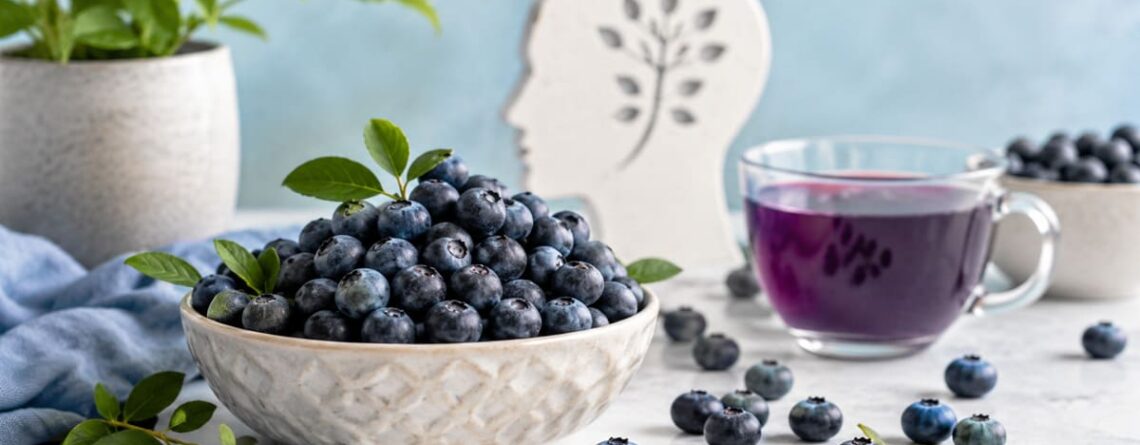
Bilberries (Vaccinium myrtillus) contain anthocyanins and other polyphenols that are being studied for possible effects on cognition, vascular function and inflammation. Human research is promising but not conclusive: some studies have reported improvements in particular cognitive measures, while others have found no significant memory benefit. Current evidence does not show that eating bilberries or taking bilberry supplements prevents dementia.
A Small Berry with a Complicated Brain Story
Bilberry looks like a smaller, darker cousin of the blueberry, but its deep blue-purple colour hints at what makes it scientifically interesting: anthocyanins, a group of plant pigments belonging to the flavonoid family. These compounds have attracted attention because laboratory and human studies suggest they may influence processes relevant to brain health, including oxidative stress, inflammation and blood-vessel function. But there is an important difference between biologically interesting and clinically proven.
So, can bilberry actually help your brain? The most honest answer is: possibly, but the evidence is still developing. That distinction matters because research on bilberry itself is much smaller than the broader literature on anthocyanin-rich foods such as blueberries, blackcurrants and other berries.
What Makes Bilberry Interesting for the Brain?
Bilberry is the fruit of Vaccinium myrtillus, a plant native to parts of Europe and northern regions of North America. It contains anthocyanins, flavonoids and other polyphenolic compounds. Anthocyanins are being investigated because they may influence several biological pathways relevant to brain function. Researchers are exploring their possible effects on oxidative stress, inflammatory signalling and vascular function, while also examining whether their metabolites can influence biological processes beyond the digestive tract.
That does not mean bilberry directly “feeds” brain cells or prevents neurological disease. Instead, the scientific question is whether regular exposure to these compounds can influence physiological systems that contribute to healthy cognitive functioning.
How Could Bilberry Connect with Cognition?
The brain depends on an adequate blood supply, balanced cellular signalling and protection from excessive oxidative and inflammatory stress. Anthocyanins may interact with these systems through several pathways, although much of the mechanistic evidence comes from laboratory or broader anthocyanin research rather than bilberry alone. Potential areas of interest include:
- Vascular function: healthier blood-vessel function may support brain perfusion.
- Oxidative stress: anthocyanins have antioxidant-related activity in laboratory models.
- Inflammatory signalling: some human studies have reported changes in inflammatory biomarkers.
- Cell signalling: anthocyanin metabolites may influence biological signalling pathways.
- Brain-related pathways: researchers are investigating possible effects on neuroplasticity and hippocampal function.
The important caveat is that biological plausibility is not proof of a cognitive benefit in humans.
What Does the Human Evidence Say?
One of the most directly relevant bilberry studies was a 2021 randomized, double-blind, placebo-controlled trial involving 60 men aged 67 and older with subjective memory impairment. Participants consumed either a bilberry/red-grape juice mixture or an energy-matched placebo for nine weeks.
The researchers found no significant difference between groups on the selected memory and motor tests. However, several blood biomarkers associated with inflammation and tissue damage changed more favorably in the bilberry/red-grape group. This is an important result because it illustrates the difference between changing a biological marker and improving cognition. The study provides evidence of biological effects, but it does not establish that bilberry improves memory. It also combined bilberry with red grape, so the findings cannot be attributed to bilberry alone.
The Anthocyanin Picture Is Bigger Than Bilberry
Because bilberry-specific trials remain limited, researchers often examine anthocyanins as a broader nutritional category. A 2025 systematic review and meta-analysis examined 30 randomized clinical trials involving anthocyanin intake in adults. Fourteen studies, involving 733 participants, had sufficient data for quantitative meta-analysis. The broader evidence suggested possible improvements across several cognitive domains, including attention, executive function, psychomotor performance and aspects of memory. However, the meta-analysis did not find statistically significant effects for working memory, verbal learning, immediate memory or delayed memory. Considerable heterogeneity existed between studies.
In other words:
Anthocyanins are promising. That does not mean bilberry has been proven to improve memory.
A Particularly Interesting Bilberry Study
The ACID trial explored purified anthocyanins derived from bilberry and blackcurrant in older adults at increased risk of dementia. The 24-week randomized, double-blind, placebo-controlled Phase II study involved more than 200 participants aged 60–80 with mild cognitive impairment and/or cardiometabolic disorders. Participants received either 320 mg/day of purified anthocyanins or placebo. The study included repeated cognitive testing and biological assessments.
The researchers did not find a significant between-group difference in episodic memory at the end of the study, although there were statistically significant differences in the trajectory, or slope, of some measures. The intervention was reported to be safe and well tolerated. Again, this is encouraging enough to justify further research; but not enough to claim dementia prevention.
The Unexpected Lesson: The “Brain Benefit” May Not Be About Memory Alone
One of the most interesting themes emerging from the research is that anthocyanins may affect multiple systems connected to brain health, rather than acting like a conventional memory enhancer. Vascular health, inflammation, metabolic health and cellular signalling can all intersect with cognition.
That means future research may reveal that the value of anthocyanin-rich foods lies less in producing a dramatic short-term memory boost and more in contributing to a broader healthy-aging environment. This remains an emerging hypothesis rather than an established clinical conclusion.
Recent Research Highlights
2026: Multi-centre randomized trial: A 24-week, three-arm randomized controlled trial studied anthocyanins delivered through diet or supplementation in adults aged 60–85 with self-reported memory complaints. The intervention used a high-anthocyanin diet or a blackcurrant-derived product rather than bilberry alone, so its findings should be interpreted as evidence about anthocyanin-rich nutrition rather than proof of a bilberry effect.
2025: Anthocyanin systematic review/meta-analysis: Thirty randomized trials were identified; 14 involving 733 participants contributed quantitative data. Several cognitive domains showed signals of benefit in the broader evidence, but key memory outcomes did not show statistically significant pooled effects, highlighting substantial uncertainty.
2025: ACID secondary analysis: Researchers used biological samples from the 24-week bilberry/blackcurrant anthocyanin trial to investigate neurogenesis-related processes and blood-based markers associated with brain health. This work is scientifically interesting but includes laboratory analyses and should not be interpreted as evidence that bilberry produces new neurons in people’s brains.
2021: Bilberry/red-grape trial: In 60 older men with subjective memory impairment, nine weeks of the combined juice did not improve the selected cognitive tests compared with placebo, although several inflammatory and tissue-damage biomarkers changed.
Recent Clinical Studies & Surveys
The human evidence specifically examining bilberry and cognition remains relatively small. The 2021 bilberry/red-grape study is one of the clearer direct examples, while the ACID research provides evidence about a standardized anthocyanin preparation containing bilberry and blackcurrant.
A separate 2025 pilot trial investigated a standardized bilberry extract in 33 healthy adults aged 25–55 using a randomized, double-blind, placebo-controlled design. The investigators reported improvements in some mood measures and explored cognitive outcomes, but the small sample and short intervention mean the results should be considered preliminary. This is precisely why bilberry should be described as an interesting research subject, not a proven cognitive supplement.
Bilberry, Brain Health and the Aging Brain
Healthy aging involves many interacting systems. Blood-vessel health, metabolic health, physical activity, sleep, social connection and nutrition can all influence cognitive wellbeing. Bilberry may fit into that picture as one source of polyphenols and anthocyanins. But it should be viewed as one food within a dietary pattern, not as a stand-alone brain-health intervention. A colourful diet containing a variety of fruits and vegetables is a more evidence-aligned goal than focusing on a single “superfood.”
How to Include Bilberries in a Brain-Healthy Diet
If you enjoy bilberries, they can be incorporated into ordinary meals rather than treated as medicine. Try:
- Adding fresh or frozen bilberries to plain yogurt or oats
- Mixing them into a fruit-and-nut breakfast
- Using them in homemade smoothies
- Combining berries with whole grains and seeds
- Choosing whole fruit rather than relying entirely on concentrated supplements
The nutritional context matters. A berry eaten as part of a balanced meal is different from assuming that a concentrated extract will reproduce every benefit associated with the whole fruit.
What About Bilberry Supplements?
This is where caution becomes particularly important. The U.S. National Centre for Complementary and Integrative Health notes that bilberry fruit is considered safe in typical food amounts, while evidence for bilberry supplements remains insufficient to establish clear health benefits. Bilberry extracts have been used in studies at doses up to 160 mg/day for up to six months and appeared well tolerated, but long-term safety information is limited. Bilberry leaves may be unsafe in high amounts or with prolonged use. If you take medication or are considering a concentrated bilberry product, discuss it with a healthcare professional rather than assuming that “natural” means risk-free.
What the Research Really Shows and What It Doesn’t
What we know
- Bilberries contain anthocyanins and other polyphenols.
- Anthocyanins are biologically active compounds being studied in relation to brain and vascular health.
- Human trials have produced some encouraging findings.
- Some studies report changes in biomarkers or selected cognitive measures.
- Research remains active, particularly in older adults.
What we don’t know
- Whether eating bilberries regularly prevents dementia.
- Whether bilberry alone improves memory in healthy adults.
- The ideal dose or duration for cognitive benefits.
- Whether concentrated extracts are better than whole berries.
- Whether benefits differ according to age, cognitive status, genetics or diet.
- Whether observed biological changes translate into meaningful long-term cognitive outcomes.
Key Takeaways
- Bilberry is scientifically interesting, but it is not a proven memory enhancer.
- Its anthocyanins are the main reason researchers are investigating its potential brain-health effects.
- Human findings are mixed and often involve anthocyanins from several foods rather than bilberry alone.
- Some studies have reported biological or cognitive signals, while others have found no meaningful improvement in memory.
- Research does not establish bilberry as a treatment for cognitive decline or a way to prevent dementia.
- Whole berries can be part of a balanced, brain-supportive eating pattern.
- Supplements deserve more caution because dose, formulation, quality and long-term safety can differ.
- The bigger lesson may be that brain health is shaped by an overall lifestyle, not one “superfood.”
FAQ (Frequently Asked Questions)
-
Is bilberry good for the brain?
Bilberry contains anthocyanins that are being studied for potential effects on brain and vascular health, but evidence that bilberry itself improves cognition remains inconclusive. -
Can bilberry improve memory?
Some studies of anthocyanin-rich foods have reported memory-related benefits, but direct bilberry research has produced mixed findings. -
Does bilberry prevent dementia?
No. There is currently insufficient evidence to say that bilberry prevents dementia. -
What makes bilberries purple-blue?
Anthocyanins are major pigments responsible for the deep blue-purple colour of bilberries. -
Are anthocyanins the same as antioxidants?
Anthocyanins have antioxidant activity, but their biological effects may involve much more than simply “fighting free radicals.” -
Is fresh bilberry better than a supplement?
There is not enough evidence to say that one is universally better for cognition. Whole fruit provides a broader nutritional matrix, while supplements provide concentrated compounds. -
Can I eat bilberries every day?
Bilberry fruit is generally considered safe in normal food amounts. -
Are bilberry supplements safe?
Short-term studies suggest that some extracts are well tolerated, but long-term safety and interactions require more evidence. -
Does bilberry improve eyesight and brain health at the same time?
Bilberry has historically been promoted for vision, but strong evidence for improving night vision in healthy people is lacking. -
Are blueberries and bilberries the same?
No. They are closely related plants in the Vaccinium genus, but bilberry generally refers to Vaccinium myrtillus. -
Can bilberry replace a healthy diet?
No. A varied dietary pattern is more important than relying on one food or supplement. -
Should someone with memory problems take bilberry supplements?
They should discuss persistent cognitive concerns with a healthcare professional rather than self-treating with supplements.
DISCLAIMER: The content of this article is intended solely for general informational purposes and is not a substitute for professional medical consultation, diagnosis, or treatment. Always seek the advice of your doctor or another qualified healthcare professional regarding any medical concerns.