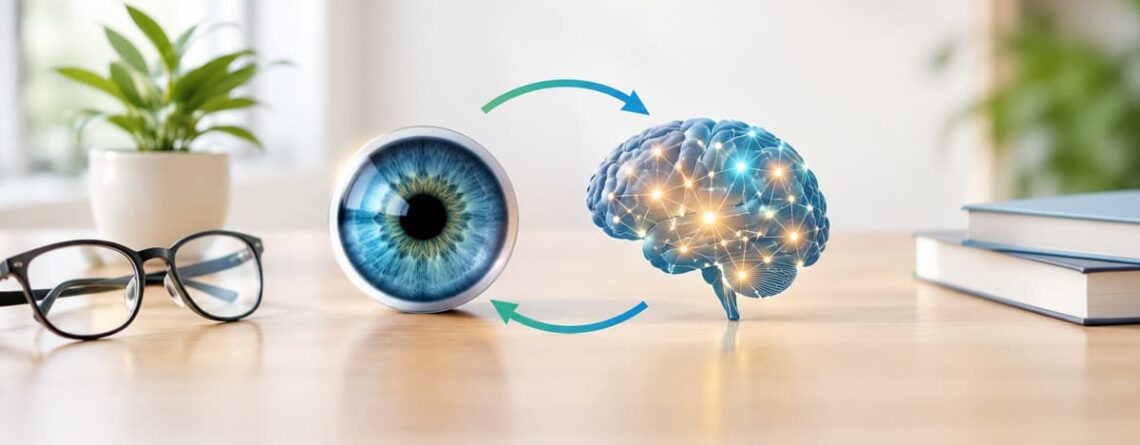
Does Vision Affect Brain Health?
Yes. Vision and cognition are closely connected because seeing is not simply an eye function. It is a brain process. The eyes capture visual information, while the retina, optic nerve and brain networks interpret it. Research in older adults consistently finds an association between vision impairment and cognitive decline, although this does not prove that poor vision directly causes dementia. Vision loss may reduce sensory input, increase cognitive effort, limit social and physical activity, and make everyday tasks more difficult. Treating correctable vision problems is therefore an important part of healthy aging and cognitive wellbeing.
Your Eyes Are Not Just Cameras
It is easy to think of the eye as a camera: light enters, an image forms and the job is finished. The reality is much more interesting. Vision begins when light reaches the retina, but the information then travels through the optic nerve and into brain regions involved in visual perception, attention, memory, spatial processing and decision-making. What you experience as “seeing” is therefore the result of continuous communication between the eyes and brain.
That is why a change in vision can affect much more than reading a road sign. If a person struggles to distinguish objects, recognize faces, read text or navigate unfamiliar surroundings, the brain may have to work harder to interpret incomplete or degraded visual information. At the same time, activities that depend on vision may become less attractive or more difficult. This creates an important distinction: vision impairment can influence cognitive performance without necessarily representing a primary cognitive disorder.
How Vision Loss Can Change Cognitive Performance
Imagine trying to complete a memory test while the words on the page are blurry. You might remember the information perfectly well, but if you cannot see the words clearly, your score can still suffer. This is one of the most important and underappreciated issues in research on vision and cognition. Many cognitive tests use visually presented material. Researchers have therefore warned that poorer performance can sometimes reflect difficulty accessing the test rather than impairment in the underlying cognitive ability. Vision-independent assessment becomes particularly important when evaluating someone with significant visual impairment.
But the relationship may extend beyond testing. Persistent vision problems can make reading, hobbies, shopping, driving, using technology or recognizing people more difficult. They may also contribute to reduced social participation, physical inactivity or greater dependence on others. Over time, these changes can reduce opportunities for cognitive stimulation and everyday engagement. So, the connection is potentially both biological and behavioural.
What Does the Research Actually Show?
A 2021 systematic review and meta-analysis published in Ophthalmology examined the bidirectional relationship between vision and cognition. The researchers found evidence that poorer vision and poorer cognition are associated with one another, supporting the idea that the relationship may run in both directions rather than being a simple one-way pathway.
Another 2021 meta-analysis examined prospective studies specifically. Across 14 cohort studies involving more than 6.2 million participants, vision impairment was associated with a relative risk of 1.47 for incident dementia. Twelve prospective studies involving 45,065 participants found a relative risk of 1.35 for cognitive impairment. These are associations, not proof that correcting vision will prevent dementia.
That distinction matters. People with vision impairment may also differ in vascular health, diabetes, socioeconomic circumstances, physical activity, social engagement and access to healthcare. Researchers continue to investigate how much of the association is explained by these factors.
Vision Is More Than 20/20
One of the most useful insights from newer research is that visual acuity is only one part of vision. Visual acuity measures how clearly you can see details. But everyday vision also depends on contrast sensitivity, depth perception, visual fields, colour discrimination and the ability to process complex visual scenes.
A 2021 longitudinal analysis from the Baltimore Longitudinal Study of Aging followed 1,202 adults, with 1,014 contributing to longitudinal analyses. Researchers examined visual acuity, contrast sensitivity and stereo acuity alongside language, memory, attention, executive function and visuospatial ability.
The results were revealing. Poorer visual acuity was associated with faster decline in some cognitive domains, while poorer contrast sensitivity was associated with decline across a broader range of domains, including language, memory, attention and visuospatial ability.
This suggests that a person can have relatively acceptable visual acuity while still experiencing other forms of visual difficulty that matter for everyday functioning.
The Brain May Pay a “Processing Cost”
One possible explanation is cognitive load. When visual information is clear, the brain can efficiently extract what matters. When information is blurred, low-contrast or incomplete, more effort may be required to identify objects, read text or navigate surroundings. Think of it like listening to someone speaking in a noisy room. You may still understand the conversation, but you have to concentrate much harder.
Vision loss can create a similar problem for the visual system. Over months or years, persistent difficulty may also change behaviour. Someone who finds reading exhausting may read less. Someone who feels unsafe walking outside may become less active. Someone who struggles to recognize faces may participate less in social gatherings. These secondary effects matter because cognitive health depends on more than what happens inside the brain in isolation.
Real-World Example: The Cataract Question
Cataracts offer a particularly interesting real-world example because they can substantially reduce visual quality and, unlike many causes of irreversible vision loss, are often treatable.
In a 2024 systematic review and meta-analysis published in Ophthalmology, researchers examined 24 articles involving 558,276 participants. Cataract surgery was associated with approximately a 25% lower risk of long-term cognitive decline compared with people with uncorrected cataracts. That sounds impressive, but it needs careful interpretation.
Most evidence in this area is observational. People who undergo surgery may differ from those who do not in healthcare access, general health, activity levels and other factors. The finding therefore supports a possible cognitive benefit of restoring vision, but it does not establish that cataract surgery prevents dementia. The more defensible conclusion is simpler: restoring useful vision may remove one potentially important barrier to healthy cognitive and everyday functioning.
A Bigger Clue From a 2024 Brain-and-Eye Study
A 2024 JAMA Network Open study used data from 304,953 UK Biobank participants to investigate eye conditions, visual acuity, brain imaging and dementia.
Cataracts were associated with higher risks of all-cause dementia, Alzheimer disease and vascular dementia in observational analyses. Poor visual acuity was also associated with higher dementia risk. The researchers went further by using Mendelian randomization, a genetic approach that can help investigate potential causal relationships. Genetically predicted cataract risk showed a possible relationship with vascular dementia, although estimates for all-cause dementia were not statistically conclusive.
Brain imaging also showed associations between cataracts and smaller total and grey-matter volumes. This does not mean cataracts “shrink the brain.” It means the observed relationships are biologically interesting and may point toward vascular or other mechanisms that deserve further investigation.
The Overlooked Connection: Vision Can Shape Your Cognitive Environment
The most useful way to think about vision and cognition may not be “bad eyesight damages the brain.” Instead, consider a broader chain:
Vision → access to information → activity → social participation → cognitive stimulation → everyday brain function.
A person with clear vision may find it easier to read, use a smartphone, cook, travel, exercise outdoors, recognize acquaintances and participate in hobbies. Someone with untreated visual impairment may gradually withdraw from some of these activities. That does not mean vision loss inevitably causes cognitive decline. It means the sensory environment surrounding the brain can influence how much information, stimulation and independence a person experiences.
The 2024 Lancet Commission on dementia prevention, intervention and care consequently added vision loss as a potentially modifiable dementia risk factor. This is a population-health finding, not a prediction about any individual person’s future.
Assessing Vision and Cognition Together
When an older adult reports memory or attention problems alongside worsening eyesight, both issues deserve consideration. A comprehensive eye examination can identify conditions such as cataracts, glaucoma, diabetic retinopathy, age-related macular degeneration and refractive problems. Some conditions are treatable or manageable, while others require long-term monitoring.
Cognitive assessment should also account for visual limitations.
A low score on a visually demanding test does not automatically mean the brain is failing. Clinicians may need to consider whether the person could see the material properly and whether vision-independent assessment is appropriate. This is particularly important for digital cognitive platforms: accessibility is not an optional design feature when visual ability can influence test performance.
Evidence-Based Ways to Protect Both Vision and Cognitive Wellness
Healthy vision begins with appropriate eye care. Adults should follow age- and risk-appropriate eye examination recommendations and seek professional assessment when vision changes. Managing conditions that affect both vascular and eye health; such as diabetes and high blood pressure is also important.
Everyday habits matter too. Staying physically active, avoiding tobacco, protecting the eyes from injury and maintaining a balanced diet support broader health, although no single lifestyle habit guarantees protection against cognitive decline. For people who develop significant visual impairment, rehabilitation can help maintain independence. Magnification, improved lighting, accessibility settings, mobility training and other adaptive strategies can reduce the practical burden of vision loss.
And perhaps most importantly, do not automatically accept worsening vision as “just aging.” Some causes of visual impairment are treatable, and identifying them early can preserve function.
Can Improving Vision Improve Cognition?
Possibly, but the evidence is not yet strong enough to promise this outcome. Cataract surgery provides some of the strongest observational evidence for a potential cognitive benefit. However, studies have produced mixed results, and randomized evidence is limited.
There are several possible explanations for an improvement after vision restoration. Better vision may make cognitive tests easier. It may increase reading and other mentally stimulating activities. It may improve mobility and social participation. It may reduce the effort required to interpret visual information. Alternatively, people who receive treatment may simply be healthier or more engaged with healthcare in ways that independently influence cognition.
The safest interpretation is therefore: treating vision impairment is valuable for vision and quality of life, and it may also support cognitive wellbeing; but it should not be marketed as a dementia treatment.
Neuroplasticity: What Might Change in the Brain?
The brain continuously adapts to changes in sensory input. When visual information becomes less reliable, other sensory and cognitive systems may become more important for navigating daily life. This adaptability is real, but “rewiring the brain” is often used far too casually.
There is currently insufficient evidence to claim that restoring vision automatically reverses age-related brain changes or permanently restores cognitive function. Neuroplasticity should instead be understood as the brain’s capacity to adapt to changing sensory demands and learn new strategies. This is one reason rehabilitation can be valuable: the goal is not simply to make vision “normal,” but to help the person use available sensory information effectively.
Recent Research Highlights
2024: JAMA Ophthalmology: A nationally representative analysis of 2,767 adults aged 71 and older found that at least one objectively measured vision impairment had a population attributable fraction of 19% for prevalent dementia. Contrast sensitivity alone had a 15% attributable fraction. Importantly, the study was cross-sectional and explicitly did not establish causation.
2024: JAMA Network Open: A UK Biobank analysis of 304,953 participants found observational associations between cataracts, poor visual acuity and dementia. Genetic analyses provided stronger evidence for a possible relationship between cataracts and vascular dementia, while the causal evidence for all-cause dementia remained uncertain.
2024: Ophthalmology: A systematic review and meta-analysis of 24 articles involving 558,276 participants found cataract surgery was associated with a 25% lower risk of long-term cognitive decline compared with uncorrected cataracts. Because much of the evidence was observational, residual confounding remains possible.
2024: Frontiers in Public Health: Research examining visual impairment and cognitive function reinforced the association between poorer vision and cognitive difficulties while highlighting possible pathways involving reduced sensory input, social isolation and functional limitations.
Recent Clinical Studies & Surveys: What We Still Need to Know
The research field is moving beyond the simple question, “Does poor eyesight predict dementia?” Researchers are increasingly asking whether particular visual functions, especially contrast sensitivity, visual fields and spatial vision, have different relationships with specific cognitive domains.
Another major question is whether treating correctable vision impairment changes long-term cognitive trajectories. Observational evidence from cataract surgery is encouraging, but randomized and carefully controlled studies are needed to separate the effect of vision restoration from differences in health, healthcare access and lifestyle.
Researchers also need better cognitive assessments for people with visual impairment. Standard cognitive batteries were often designed around people who can see printed or digital stimuli clearly, creating a measurement problem that can blur the distinction between sensory impairment and cognitive impairment.
A Practical Perspective
Consider two older adults who both begin struggling with a memory test. One has genuinely developed a cognitive problem. The other has significant visual impairment and cannot comfortably read the test instructions. Their scores might look similar. Their underlying problems are not.
That is why good cognitive care increasingly needs a whole-person perspective. Vision, hearing, mobility, sleep, mood, vascular health and cognition can interact. Understanding those connections can lead to more accurate assessment and more appropriate support.
Key Takeaways
- Vision is a brain process, not simply an eye function.
- Vision impairment is consistently associated with cognitive decline, but association does not prove causation.
- Visual acuity is only one component of vision; contrast sensitivity and other visual functions may also matter.
- Poor vision can affect cognition indirectly by reducing reading, activity, independence and social engagement.
- Visual impairment can also interfere with visually based cognitive tests.
- Cataract surgery is associated with better cognitive outcomes in observational research, but it should not be considered a dementia treatment.
- Treatable vision problems deserve timely professional evaluation.
- Cognitive wellness should be considered alongside sensory health rather than separately from it.
- RecallLoop can support cognitive monitoring and wellness tracking, but it does not replace professional eye or neurological assessment.
FAQ (Frequently Asked Questions)
-
Can poor eyesight affect memory?
Yes, indirectly and potentially directly through increased cognitive effort. However, poor eyesight does not automatically mean that memory itself is impaired. -
Is vision loss a risk factor for dementia?
Vision loss is now recognized as a potentially modifiable dementia risk factor, including in the 2024 Lancet Commission. The evidence primarily shows an association and does not mean vision loss inevitably causes dementia. -
Can cataracts affect cognition?
Cataracts are associated with cognitive decline in several observational studies. Cataract surgery has also been associated with better long-term cognitive outcomes, although causality remains uncertain. -
Can cataract surgery prevent dementia?
No. Current evidence is not strong enough to describe cataract surgery as a dementia-prevention treatment. -
Does 20/20 vision mean my visual system is healthy?
Not necessarily. Visual acuity is only one aspect of vision. Contrast sensitivity, depth perception, visual fields and other functions can also influence how effectively a person sees. -
Can vision problems make cognitive tests look worse?
Yes. Visually demanding cognitive tests can be affected by poor vision, which is why assessment may need to account for visual ability. -
Does vision loss cause brain shrinkage?
There is no basis for saying that ordinary vision loss automatically causes brain shrinkage. Some studies have found associations between specific eye conditions and brain-imaging measures, but the biological mechanisms remain under investigation. -
Can improving eyesight improve thinking?
It may help some people, particularly when better vision makes reading, activity, communication and daily tasks easier. However, cognitive benefits are not guaranteed. -
What eye conditions are linked with cognitive health research?
Researchers have investigated cataracts, visual impairment, diabetic retinopathy, glaucoma, age-related macular degeneration and other forms of visual dysfunction. The strength of evidence varies between conditions. -
How often should I have my eyes checked?
The appropriate interval depends on age, existing eye conditions, medical history and risk factors. An eye-care professional can recommend the appropriate schedule. -
Can RecallLoop diagnose cognitive decline caused by vision problems?
No. RecallLoop can support cognitive assessment and longitudinal monitoring, but cognitive results should be interpreted alongside sensory abilities and professional clinical evaluation when concerns arise. -
What is the biggest lesson about vision and brain health?
Think beyond “eyesight.” Vision determines how the brain receives and interacts with information from the environment. Protecting useful vision can therefore support independence, engagement and overall cognitive wellbeing.
DISCLAIMER: The content of this article is intended solely for general informational purposes and is not a substitute for professional medical consultation, diagnosis, or treatment. Always seek the advice of your doctor or another qualified healthcare professional regarding any medical concerns.