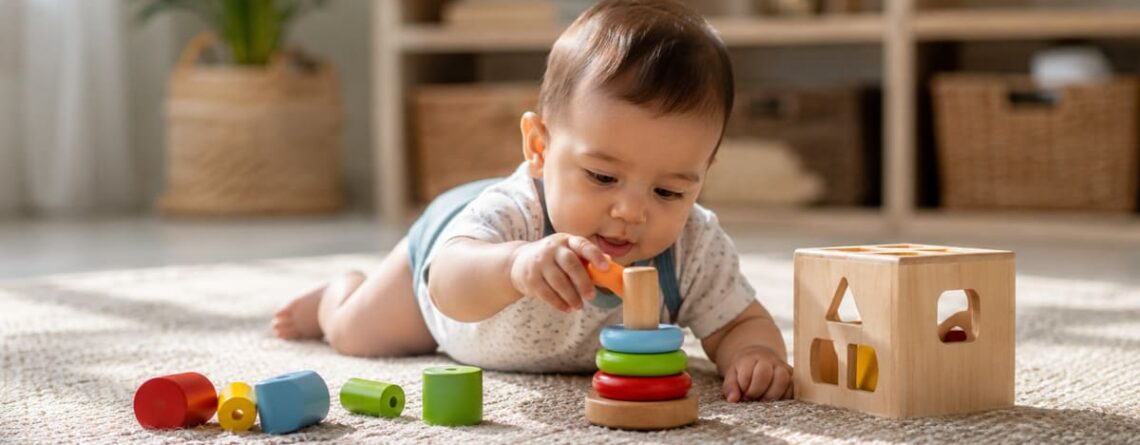
Babies can learn, detect patterns, form expectations and make simple causal inferences before they can speak. Research using looking-time, eye-tracking, behavioural and EEG methods shows that infants can recognize statistical regularities, anticipate events and respond differently when physical or social events violate their expectations. This does not mean babies possess adult-like formal logic; rather, they appear to have early learning and reasoning mechanisms that help them make sense of a complicated world before language develops.
A baby cannot explain why a ball disappeared behind the sofa. They cannot tell you that one event probably caused another. They cannot say, “I’ve seen this pattern before.”
But that does not mean their brain is simply waiting for language to switch on. Long before a child can say “because,” the developing brain is already busy detecting regularities, predicting what might happen next and learning how people and objects behave. Researchers study these abilities by observing where babies look, how long they look, whether their eyes anticipate an event and how their brain activity changes. The result is a fascinating picture: babies are not miniature adults, but neither are they passive observers. They are active learners.
What Does “Thinking Before Talking” Actually Mean?
Thinking in infancy does not look like adult reasoning. A baby is not silently constructing a formal syllogism or solving a mathematics problem. Instead, early cognition includes processes such as recognizing patterns, remembering events, predicting outcomes, distinguishing familiar from unfamiliar information and learning relationships between actions and consequences.
Researchers often describe some of these abilities as statistical learning. Infants can pick up regularities simply from repeated exposure, without someone explicitly teaching them what to notice. Reviews of the field show this ability across language, vision, music, actions and other domains. That is one reason language should not be treated as the starting point of intelligence. Language eventually gives children a powerful system for expressing and refining thoughts, but important forms of learning are already underway before fluent speech.
The Tiny Statistician: How Babies Detect Patterns
Imagine hearing:
ba – di – go
ba – di – go
ba – di – go
An adult immediately notices the repeated structure. Surprisingly, infants can also detect statistical regularities in streams of information.
One landmark line of research found that 8-month-old infants could learn transitional patterns in speech syllables after only a few minutes of exposure, without explicit teaching or reinforcement. Subsequent research has extended statistical-learning findings across auditory and visual domains.
This matters because fluent speech does not come with spaces between words. Infants have to work out which sounds tend to occur together and which combinations are likely to form meaningful units. Their brains are, in effect, asking:
“What tends to go with what?”
That simple question is a powerful foundation for learning.
Cause and Effect: “Did That Make This Happen?”
Pattern detection is only part of the story. Babies also appear capable of learning about causal relationships. For example, if one object repeatedly interacts with another and something happens afterward, infants can develop expectations about what should happen next.
A 2009 study tested 5- to 6.5-month-old infants using physical events involving objects that were either inert or appeared to move on their own. The researchers found that infants developed different expectations depending on the object’s apparent properties, including whether it could move independently or obey physical constraints.
Another set of experiments found evidence of causal representations in 8-month-old infants when they watched an object appear to produce a change behind a screen. The infants responded differently when the expected causal relationship was violated.
These findings suggest that infants are not merely recording isolated events. They can begin building expectations about relationships between events.
Even Younger Than You Might Think
Some findings push the timeline even earlier.
A 2013 study reported that newborns only a few hours old preferred visual events containing certain physical-causality cues over carefully matched non-causal events. The authors proposed that basic sensitivity to particular spatiotemporal patterns might be available extremely early, potentially reflecting an early-developing mechanism rather than extensive visual experience. However, this should not be interpreted as proof that newborns possess a complete understanding of causality. Looking preferences are indirect measures of cognition, and researchers continue to debate how much of early causal understanding is innate, learned or produced by an interaction between the two. That distinction is important.
Early sensitivity is not the same as adult-level reasoning.
The 16-Month-Olds Who Looked for Better Evidence
A particularly revealing 2024 study examined 66 infants around 16 months old using simultaneous EEG and eye tracking. The researchers presented evidence that differed in how informative it was for figuring out a causal relationship. The infants showed increased theta activity when anticipating more informative evidence, and the difference was stronger among infants who subsequently made correct predictions about the causal event.
The intriguing finding was not simply that infants learned cause and effect. It suggested that some infants could recognize which evidence would be more useful for figuring out what was happening. That begins to resemble a much more sophisticated learning process:
Observe → evaluate information → predict → update understanding.
Learning Without Words
Language certainly transforms cognition. Once children can use words such as because, before, after, if, and maybe, they gain powerful tools for representing relationships explicitly. But the underlying learning does not necessarily begin with those words.
A 2024 review of causal learning in infancy and childhood describes two major approaches to understanding early causal reasoning: explanation-based learning and Bayesian approaches. Both attempt to explain how children learn relationships between events before and alongside increasingly sophisticated language. This suggests an important developmental principle:
Language may help children express and refine reasoning that the brain has already begun building nonverbally.
A Real-World Example
Consider an illustrative example, not a documented patient. A 10-month-old repeatedly watches a parent press a button and hears a sound. Eventually, the baby begins looking toward the speaker immediately after the button is pressed, even before the sound occurs.
The baby has not learned the word “button.” They cannot explain the relationship. But their behaviour suggests that they have formed an expectation:
Button → sound.
That expectation is a tiny piece of predictive knowledge.
The Unexpected Part: Babies Learn by Watching
Infants do not always need to perform an action themselves to learn its consequences.
A 2017 study examined observational causal learning across three experiments. Infants learned about physical causal events, social causal events and probabilistic outcomes simply through observation. Learning was more difficult when the cause-effect relationship was probabilistic rather than consistent. This is significant because much of early learning happens while babies watch other people.
A caregiver does something. Something happens. The baby watches. And the brain begins collecting evidence.
Research Findings: What Is Established and What Is Not?
The strongest evidence supports the idea that infants are capable of statistical learning, expectation formation and forms of causal learning before fluent language. These abilities appear across multiple sensory domains and can emerge remarkably early. However, scientists should be cautious about calling these abilities “logic” in exactly the same sense as adult formal reasoning.
Infant studies often rely on indirect measures such as looking time, anticipatory eye movements, reaching or brain activity. A baby looking longer at an unexpected event demonstrates that something about the event captured attention, but it does not by itself reveal exactly what the baby consciously understood.
So “hidden logic” is a useful metaphor, not a claim that babies are performing adult-style logical proofs.
How Do Researchers Know What a Baby Is Thinking?
Researchers cannot simply ask an infant what they understood. Instead, they use carefully designed experiments. Common methods include:
- Looking-time experiments: Babies often look longer at unexpected or novel events.
- Violation-of-expectation tasks: Researchers establish a pattern and then change it to see whether infants respond differently.
- Eye tracking: Researchers measure where and when infants look, including whether they anticipate an event.
- EEG: Brain activity can reveal changes in neural processing while infants observe information.
- Habituation: Researchers repeatedly show an event and then test whether a change attracts renewed attention.
These methods provide valuable evidence, but each measures behaviour indirectly. That is why conclusions should focus on what the experiments demonstrate rather than assuming babies have adult-like conscious explanations.
Can Babies Really “Reason”?
Yes, but with an important qualification. Infants demonstrate early forms of reasoning, particularly around patterns, physical events, probabilities and social information. They do not demonstrate the full abstract reasoning system of an older child or adult.
Interestingly, more explicit logical reasoning becomes increasingly visible later in development. A 2024 study of 36 toddlers aged approximately 2.3–3.2 years found that children used disjunctive inference across word learning, social knowledge and determining the winner of a race; for example, effectively reasoning that if there are two possibilities and one has been ruled out, the other must remain.
This provides a useful developmental bridge: early pattern detection and causal learning may provide foundations upon which increasingly explicit reasoning develops.
How Parents and Caregivers Can Support This Hidden Learning
Babies do not need formal lessons in logic. Their everyday environment already provides thousands of learning opportunities. What adults can do is make those opportunities richer and more responsive.
- Talk through cause and effect: “You pushed the button, and now the light came on.”
- Pause before revealing an outcome: Give babies a chance to predict what comes next.
- Repeat meaningful patterns: Songs, routines and simple games allow infants to detect regularities.
- Let them explore safely: Reaching, dropping, stacking and manipulating objects provide information about physical relationships.
- Follow their attention: If a baby is fascinated by something, use that moment rather than redirecting them unnecessarily.
- Use responsive interaction: Back-and-forth exchanges give infants opportunities to connect actions, expressions and outcomes.
Research increasingly views the infant’s everyday environment as part of their learning system. Work using head cameras and eye tracking suggests that as infants begin sitting, crawling and walking, their changing physical abilities expose them to different kinds of information. In other words, development changes what the baby can see and what the baby can learn from.
The Importance of Cognitive Engagement
Cognitive engagement in infancy does not mean giving a baby flashcards all day. It means providing opportunities to notice, explore, predict, interact and discover.
A spoon that falls from a high chair becomes a physics lesson. A caregiver hiding behind a blanket becomes a lesson in persistence and prediction. A repeated song becomes a pattern-learning exercise. A game of peekaboo becomes an opportunity to anticipate disappearance and return. The brain does not need every experience to be educational. Ordinary interaction is already rich with information.
Neuroplasticity and the Developing Brain
Early childhood is a period of substantial brain development and plasticity. Neural systems are shaped by a combination of biological maturation and experience. But “plastic” does not mean that every experience permanently rewires the brain or that parents must optimize every minute of a child’s day. Development is more nuanced. Research on infant statistical learning suggests that learning mechanisms interact with the child’s changing sensory, motor and social environment. The practical message is reassuring:
consistent, responsive, varied experiences matter more than trying to create a perfect learning environment.
Recent Research Highlights
2024: Causal learning review: A major review synthesized theories explaining how infants and young children learn causal relationships, highlighting the interaction between computational learning mechanisms and language-based experiences.
2024: EEG and eye-tracking study: In a study of 66 16-month-olds, researchers found neural and behavioral evidence that infants could distinguish more informative from less informative causal evidence and that this sensitivity was related to later prediction accuracy.
2024: Social norms study: A preregistered Scientific Reports study investigated 11-month-old infants and reported evidence that preverbal infants understood an important aspect of social norms; showing that early cognition extends beyond physical objects into the social world.
2018: Infant statistical learning review: Researchers concluded that infants can extract regularities across language, vision, music and other domains, supporting the view that statistical learning is a broad early learning mechanism.
Recent Clinical Studies & Surveys
This topic is primarily developmental rather than clinical, so the strongest evidence comes from experimental developmental studies and longitudinal research rather than clinical trials. Studies using behavioural observation, eye tracking and EEG provide converging evidence for early pattern detection, prediction and causal learning. However, these experiments generally involve relatively small samples and highly controlled situations.
That means researchers can confidently say that infants demonstrate specific learning behaviours under particular experimental conditions, but they cannot automatically conclude that every infant possesses the same ability to the same degree or that these findings directly predict later intelligence.
In a 2025 study, researchers investigated whether babies could combine information and draw simple conclusions before they could speak fluently. It reinforced, Babies expressed early forms of compositional reasoning before they could speak effortlessly.
What did the experiments reveal?
- Experiment 1 – Understanding words: 14-month-old babies could connect words such as “don’t want” with the object being discussed and use that information to predict what would happen next.
- Experiment 2 – Understanding facial cues: 12-month-old babies could understand a “not face” and connect the facial expression with a particular object, even without words.
- Experiment 3 – Mental problem-solving: 10-month-old babies could mentally combine and transform information about a hidden physical event, showing basic reasoning abilities before they could use language.
Key Findings from the Three Experiments
- 14-month-olds could combine words such as “don’t want” with an object label to interpret a simple negative sentence.
- 12-month-olds could apparently combine a non-verbal “not face” with an object to predict an actor’s likely choice.
- 10-month-olds demonstrated evidence of combining and transforming representations of a physical scene, without relying on language.
- The ability being tested was compositionality—the capacity to combine simpler pieces of information into a more complex representation.
- The particularly striking finding was that evidence for this ability appeared before infants could reliably use compositional language.
- The researchers therefore suggest that compositional thinking may not originate entirely from language; simpler cognitive mechanisms may already support it during infancy.
- The study does not show that babies possess adult-like formal logic. Rather, it provides evidence for early cognitive processes that can combine information and generate expectations.
What Does This Mean for Cognitive Health?
The bigger lesson extends beyond babies. Human cognition is built from layers. Attention helps us select information. Statistical learning helps us detect regularities. Memory allows those regularities to accumulate. Prediction lets us anticipate what may happen. Language eventually gives us increasingly powerful tools to represent and communicate what we have learned.
Understanding infancy therefore offers a window into how sophisticated human cognition develops from surprisingly basic learning mechanisms.
Key Takeaways
- Babies can learn before they can speak.
- Infants detect statistical patterns in sounds, sights and other experiences.
- Some studies show surprisingly early sensitivity to physical causality.
- Babies can develop expectations about what should happen next.
- Infants can learn some causal relationships through observation alone.
- A 2024 EEG/eye-tracking study found evidence that some 16-month-olds could evaluate the informativeness of causal evidence.
- “Hidden logic” does not mean babies possess adult-style formal logic.
- Looking behavior and other infant measures provide indirect evidence of cognition.
- Everyday play, exploration and responsive interaction provide rich learning opportunities.
- Language does not create cognition from nothing; it becomes an increasingly powerful tool for expressing, organizing and extending developing thought.
FAQ (Frequently Asked Questions)
-
Can babies think before they can talk?
Yes. Research shows that infants can learn patterns, form expectations, recognize relationships and make simple predictions before they can communicate through spoken language. -
Do babies understand cause and effect?
They demonstrate early forms of causal learning, particularly involving physical and social events, although this understanding is not equivalent to adult causal reasoning. -
How young can babies detect patterns?
Evidence suggests statistical learning abilities emerge very early. Research has even found newborn sensitivity to particular visual regularities, while classic statistical-learning experiments demonstrated learning in 8-month-olds after brief exposure. -
Can babies predict what will happen next?
Yes. Infants can form expectations based on repeated patterns and causal relationships, sometimes showing anticipatory looking before an expected event occurs. -
Does this mean babies have adult-like logic?
No. “Logic” in this context refers to early reasoning and inference, not formal mathematical or symbolic logic. -
How do scientists know what babies understand?
Researchers use measures such as looking time, eye tracking, reaching, habituation, violation-of-expectation tasks and EEG to infer how infants process information. -
Can babies learn simply by watching?
Yes. Research has demonstrated observational learning of both physical and social causal relationships. -
Does talking to babies improve cognitive development?
Responsive interaction provides valuable opportunities for language, attention, social learning and prediction. However, no single activity guarantees a particular cognitive outcome. -
Should parents teach babies logic?
Formal logic lessons are unnecessary. Everyday exploration, play, conversation, repetition and opportunities to predict and discover provide developmentally appropriate cognitive stimulation. -
Does early reasoning predict intelligence later & what is statistical learning in babies?
Some early cognitive abilities are associated with later development, but individual infant experiments should not be used to predict a child’s future intelligence.
Statistical learning is the ability to detect regularities or probabilities in incoming information, such as which sounds, objects or events tend to occur together. -
When should parents be concerned about development?
Development varies considerably, but concerns about communication, movement, social interaction, learning or loss of previously acquired skills should be discussed with a paediatrician or qualified developmental professional.
DISCLAIMER: The content of this article is intended solely for general informational purposes and is not a substitute for professional medical consultation, diagnosis, or treatment. Always seek the advice of your doctor or another qualified healthcare professional regarding any medical concerns.