Tiny Ears, Busy Brain: How Singing Shapes Early Development
Singing to babies may support early brain development by combining speech, rhythm, pitch, repetition and social interaction. Research suggests that infant-directed singing can capture babies’ attention, support emotional regulation and provide structured auditory patterns relevant to early language learning. Studies have also found associations between caregiver singing and later vocabulary development. However, singing has not been proven to make babies more intelligent, and much of the evidence is observational or based on short-term responses. Its greatest value may lie in the combination of sound, repetition and responsive caregiver interaction.
Why Does a Baby’s Brain Respond So Strongly to Singing?
A baby may not understand the words in a lullaby, but that does not mean the brain is hearing “nothing.” Singing combines several features that are highly noticeable to developing auditory systems: changes in pitch, rhythm, timing, intensity and repetition. Caregivers also tend to exaggerate these features when singing to infants, producing what researchers call infant-directed singing. This style of singing is often slower, more melodic and more expressive than ordinary adult-directed singing, creating a rich but predictable auditory signal for a developing brain.
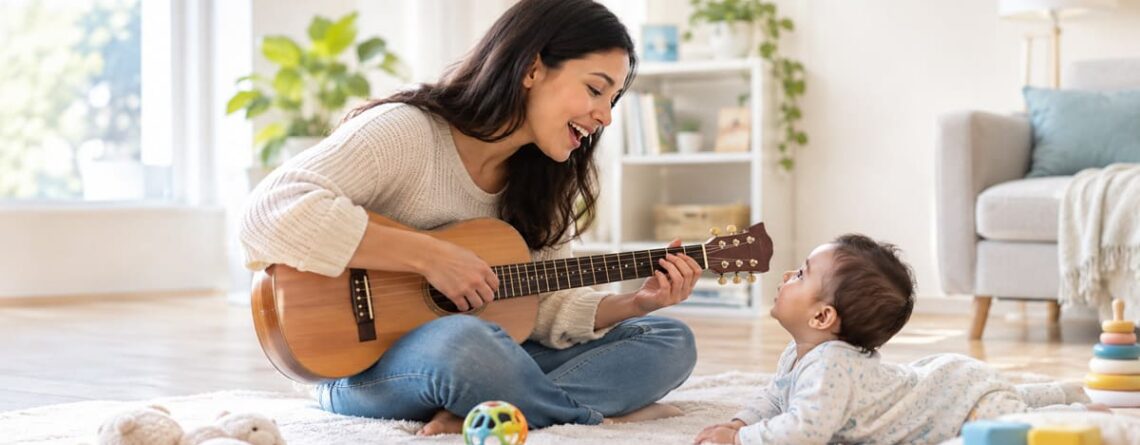
Singing is also different from simply playing recorded music. When a parent or caregiver sings directly to a baby, the infant receives sound together with facial expression, eye contact, movement, emotional cues and opportunities for turn-taking. The experience therefore involves auditory processing, attention, social engagement and emotional regulation at the same time. That combination may be one reason researchers increasingly view infant singing as a form of early communication rather than merely entertainment.
The Newborn Brain Is Already Listening
The auditory system begins processing meaningful patterns remarkably early. A 2026 study published in Communications Psychology used functional near-infrared spectroscopy to examine how 40 newborns responded to speech, singing and hummed melodies. Both speech and singing produced stronger responses than humming in right temporoparietal regions, while the neural responses to singing and speech were not significantly different from each other.
The researchers proposed that singing, like speech, may therefore provide salient auditory input to the newborn brain and potentially contribute to early speech perception. Importantly, this study measured neural responses rather than later language outcomes, so it does not demonstrate that singing causes better language development. It does, however, show that the newborn brain is capable of responding meaningfully to the combined musical and linguistic structure of song.
Singing Turns Sound Into a Pattern the Brain Can Follow
Language is made up of continuously changing sounds, and babies have to learn to detect patterns within that stream. Singing naturally organizes sound into rhythm, repetition and predictable sequences, potentially making some acoustic patterns easier for infants to track. This does not mean babies learn language simply by listening to songs, but singing may provide an unusually structured auditory environment in which speech-like sounds occur alongside exaggerated pitch and rhythmic cues.
Research with seven-month-old infants provides a particularly interesting example. In a study involving 60 mother-infant dyads, researchers examined infants’ neural tracking and rhythmic movements during live maternal singing. Infants’ brains tracked the acoustic structure of the singing, with stronger neural tracking for lullabies than playsongs in one part of the experiment. In a separate analysis, infants showed more rhythmic movement during playsongs, and both neural coordination and rhythmic movement during playsongs were positively associated with expressive vocabulary measured at 20 months. Because these were associations rather than randomized interventions, they cannot establish that singing caused later vocabulary differences. Nevertheless, the findings suggest that infants are not passive listeners: their brains and bodies actively coordinate with the musical structure of a caregiver’s voice.
Singing May Help Build the Foundations of Language
One of the most intriguing connections between singing and development is vocabulary. A 2021 study examined parent-infant singing interactions and found that six-month-old infants preferred sung over instrumental versions of unfamiliar melodies. Among the families studied, higher reported levels of parent-infant singing were also associated with more favorable language outcomes during the second year of life. The researchers interpreted these findings in terms of developmental plasticity, but the study was relatively small and relied partly on parent-reported singing behavior, so it cannot prove that singing itself produced the later language advantage.
More recent research continues to point toward the importance of the home musical environment. A 2025 exploratory longitudinal study of 43 caregiver-infant dyads found that parental singing and the overall home music environment were associated with infants’ vocabulary comprehension, vocabulary production and gestures. Interestingly, parents’ social motivation was more strongly related to the home music environment than formal musical training. This reinforces an important point for families: a parent does not need to be musically trained to create meaningful musical experiences for a baby.
The Voice May Matter More Than Musical Perfection
Parents sometimes worry that they cannot sing well enough for their baby. Developmental research offers little reason to think babies require technically impressive singing. What makes infant-directed singing distinctive is not professional musical quality but the communicative qualities of the voice: pitch movement, rhythm, repetition, vocal intensity and emotional expression.
A prospective study of 236 Palestinian mothers singing to their six-month-old infants examined specific acoustic characteristics of maternal singing. Among 219 completed recordings, greater pitch variability and richer vocal amplitude and vibration were associated with better reported or assessed developmental outcomes across sensorimotor, language-vocalization and socioemotional domains. Some acoustic characteristics also predicted outcomes at 18 months. Because this was an observational study, the findings should be interpreted as associations rather than proof that particular singing techniques cause better development. Still, they suggest that the way caregivers sing may influence the richness of the infant’s auditory experience.
Singing Is Also a Social Conversation
A lullaby may sound like a one-way activity, but live singing can become a form of early conversation. Babies look toward the caregiver, move their bodies, vocalize, smile, pause and sometimes attempt to join the interaction. The caregiver can then respond, creating a cycle of turn-taking.
This matters because early communication is not built only from words. Timing, attention, facial expression, vocal responses and shared engagement all contribute to the foundations of social communication. A 2024 study of everyday caregiver-infant communication showed that infant-directed communication is highly multidimensional, with speech frequently occurring alongside gesture, action, emotion and touch. Singing naturally combines several of these channels, making it a particularly rich form of caregiver-infant interaction.
Singing May Help Regulate Emotion
A systematic review published in 2023 examined 21 studies of live parental infant-directed singing and identified three broad areas of impact: infant emotional regulation, validation of the parent’s caregiving role and affective attunement between parent and infant. The review found particularly consistent benefits among typically developing full-term infants, while evidence involving preterm infants was less consistent.
This emotional dimension is important because cognitive development does not occur separately from regulation. A baby who becomes calmer, more attentive or more socially engaged may have greater opportunity to interact with the caregiver and absorb language and environmental information. Singing therefore may influence development indirectly as well as directly: the song itself provides structured sound, while the interaction surrounding it can support regulation and connection.
Singing Does Not Need to Be a “Brain Training Exercise”
The most useful message for parents is also the simplest: singing does not need to become another performance target. There is no established requirement for a particular number of songs, musical genre, vocal range or daily duration that guarantees cognitive benefits. The research does not support the idea that playing classical music or singing a certain type of song will make a baby more intelligent.
Instead, singing can be viewed as an easy way of increasing responsive interaction. A caregiver can sing during feeding, bathing, dressing, rocking, walking or play. Repetition can make songs familiar, while changing lyrics or responding to the baby’s sounds can introduce variation and turn the activity into a two-way exchange.
Lullabies and Play Songs May Serve Different Purposes
Not all infant-directed singing is the same. Lullabies tend to be slower and more soothing, while play songs often contain greater rhythmic movement, repetition and variation. Research with seven-month-olds found differences in neural tracking and movement responses between lullabies and playsongs, suggesting that the acoustic structure of singing may influence how infants engage with it.
This does not mean one type is better. A lullaby may be particularly suited to calming and emotional regulation, while a playful song may encourage movement, anticipation and active engagement. The most developmentally useful approach may therefore be variety within a warm and responsive relationship.
What About Preterm Babies?
Singing has also been investigated in neonatal and preterm populations because parental voice can provide meaningful auditory stimulation during a period when infants may experience separation from caregivers and an unfamiliar hospital environment. A randomized controlled trial involving 45 preterm infants found that repeated parental singing during kangaroo care improved neural processing of speech-sound changes at term age compared with standard kangaroo care. However, longer-term outcomes are less straightforward. Another randomized trial involving 74 preterm infants found no significant differences in cognitive or language outcomes at two to three years between children whose parents received a singing intervention and those in the control group.
These apparently different findings illustrate why evidence must be interpreted at the correct level. Singing may influence particular aspects of auditory processing without necessarily producing measurable long-term differences in standardized cognitive or language scores. It is promising as a supportive interaction, but it should not be presented as a proven developmental treatment for preterm infants.
Neuroplasticity: Singing Provides Repeated, Meaningful Input
Early development is characterized by rapid changes in the brain as infants encounter language, movement, social interaction and sensory information. Repeated experiences help shape developing neural systems, but “neuroplasticity” should not be interpreted as meaning that every repeated activity permanently rewires the brain.
Singing provides repeated auditory patterns within an emotionally meaningful relationship. Over time, infants encounter recurring rhythms, sounds, words, pauses and turn-taking sequences. These experiences may provide opportunities for the developing brain to become increasingly efficient at detecting relevant patterns. Current evidence supports this as a plausible developmental mechanism, but researchers still cannot specify exactly how much singing is necessary or which neural changes translate into meaningful long-term outcomes.
A Real-World Example: The Same Song, Different Developmental Opportunities
Consider a caregiver who sings the same simple song while changing a baby’s clothes each morning. At first, the infant simply listens. After repeated exposure, the baby may begin anticipating a familiar phrase, smiling at a particular sound, moving rhythmically or vocalizing during a pause. The caregiver notices the response and repeats the phrase or waits for the baby to respond. What began as a song has now become a sequence involving memory, prediction, attention, emotional engagement and social turn-taking. Now imagine a parent singing the same gentle song during bedtime each night. Over time, the baby may begin to recognize the melody, rhythm and familiar voice. The predictable patterns can capture the baby’s attention while the interaction also provides opportunities for emotional connection and early communication.
The developmental value in this example is not that the song contains a special collection of “brain-boosting” notes. It is the repeated, responsive interaction surrounding the song that creates multiple opportunities for learning.
Recent Research Highlights
The most important recent development is the growing ability to study what happens inside the infant brain during naturalistic musical experiences. The 2026 newborn study using fNIRS found that 40 newborns showed stronger right temporoparietal responses to speech and singing than to humming, suggesting that song may be a salient form of early auditory input. Meanwhile, studies in older infants are linking neural tracking and rhythmic movement during caregiver singing with later vocabulary measures. Together, these findings are shifting the research question from whether babies “like music” toward how their developing brains process the timing, pitch, rhythm and social structure embedded in singing.
At the same time, the evidence remains appropriately cautious. Many studies are observational, involve relatively small samples or measure short-term neural and behavioural responses rather than long-term developmental outcomes. Singing may support language and social development, but it is unlikely to be a single independent cause of those outcomes. The broader caregiving environment, including conversation, play, responsiveness, sleep, health and socioeconomic conditions also contributes to development.
Recent Clinical Studies & Surveys
Research involving infants and children is increasingly combining behavioural observation with EEG, fNIRS, developmental assessments and longitudinal follow-up. The evidence is particularly interesting in preterm infants, where controlled studies have examined whether parental singing during kangaroo care can influence auditory processing. However, the difference between short-term neural effects and long-term developmental outcomes remains important. Current evidence supports singing as a potentially beneficial, low-cost form of caregiver interaction, but it does not establish singing as a clinical treatment for developmental delay, language disorder or cognitive impairment.
Research on infant-directed singing suggests that babies are particularly responsive to its rhythmic and melodic qualities. Singing can help hold their attention, support emotional regulation and create repeated opportunities to experience patterns in sound.
Key Takeaways
- Singing gives babies a rich combination of rhythm, pitch, repetition, speech and social cues.
- Newborn brains respond measurably to singing, with 2026 research showing neural responses comparable to those elicited by speech in specific regions.
- Infant-directed singing can capture attention and promote active neural and rhythmic coordination.
- Several studies associate caregiver singing with later language or vocabulary outcomes, although causality remains uncertain.
- Live singing is different from simply playing recorded music because it includes social interaction and responsiveness.
- Parents do not need formal musical training or a “perfect” voice.
- Lullabies and play songs may provide different kinds of engagement.
- Singing may support emotional regulation and parent-infant attunement.
- Evidence in preterm infants is promising for some neural outcomes but mixed for longer-term cognition and language.
- Singing should be viewed as a meaningful everyday interaction; not a guaranteed brain-boosting intervention.
FAQ (Frequently Asked Questions)
-
Does singing help a baby’s brain develop?
Research suggests that singing provides rich auditory and social input that may support attention, language learning and emotional regulation, but it has not been proven to independently improve overall intelligence. -
Should parents sing to newborn babies?
Yes. Singing is a simple way to provide responsive auditory and social interaction. There is no need for musical training or elaborate songs. -
Does singing help babies learn language?
It may contribute to early language development by providing rhythmic, repetitive and speech-related patterns. Studies have found associations between parent-infant singing and later vocabulary, but these findings do not prove that singing alone causes better language outcomes. -
Is singing better than talking to a baby?
Not necessarily. Singing and speech provide different acoustic experiences, and both can support interaction. Singing may add stronger rhythm, pitch variation and repetition, while ordinary conversation provides rich opportunities for language learning and turn-taking. -
Does a baby understand the words in a lullaby?
A young baby may not understand the meaning of the words, but the brain can still process features such as rhythm, pitch, timing and vocal patterns. -
Do babies prefer singing to speaking?
Infants can show strong engagement with infant-directed singing, and some studies suggest preferences for sung material under particular experimental conditions. Preferences vary with age, context and the characteristics of the song. -
Does classical music make babies smarter?
There is no good evidence that simply playing classical music makes babies more intelligent. Interactive singing and communication are more relevant to the developmental research discussed here. -
Does a parent need to sing well?
No. Babies are not judging vocal technique. The responsive, expressive and socially meaningful qualities of caregiver singing are likely more important than musical perfection. -
Can singing calm a crying baby?
Singing can sometimes support infant emotional regulation, and systematic-review evidence suggests benefits for regulation and parent-infant attunement. However, no single strategy works for every baby. -
Can singing help premature babies?
Some controlled research has found effects on auditory or neural processing in preterm infants, but evidence for long-term cognitive and language improvement is mixed. Singing should complement, not replace, neonatal and developmental care. -
How often should parents sing to their baby?
There is no scientifically established ideal frequency or duration. Singing naturally during everyday routines is a practical way to incorporate it without turning it into a formal training program. -
What is the biggest benefit of singing to a baby?
Its value may come from the combination of sound, repetition, attention, emotional expression and responsive interaction. In that sense, singing is not merely music. It can become an early form of communication and shared learning.
DISCLAIMER: : The content of this article is intended solely for general informational purposes and is not a substitute for professional medical consultation, diagnosis, or treatment. Always seek the advice of your doctor or another qualified healthcare professional regarding any medical concerns.